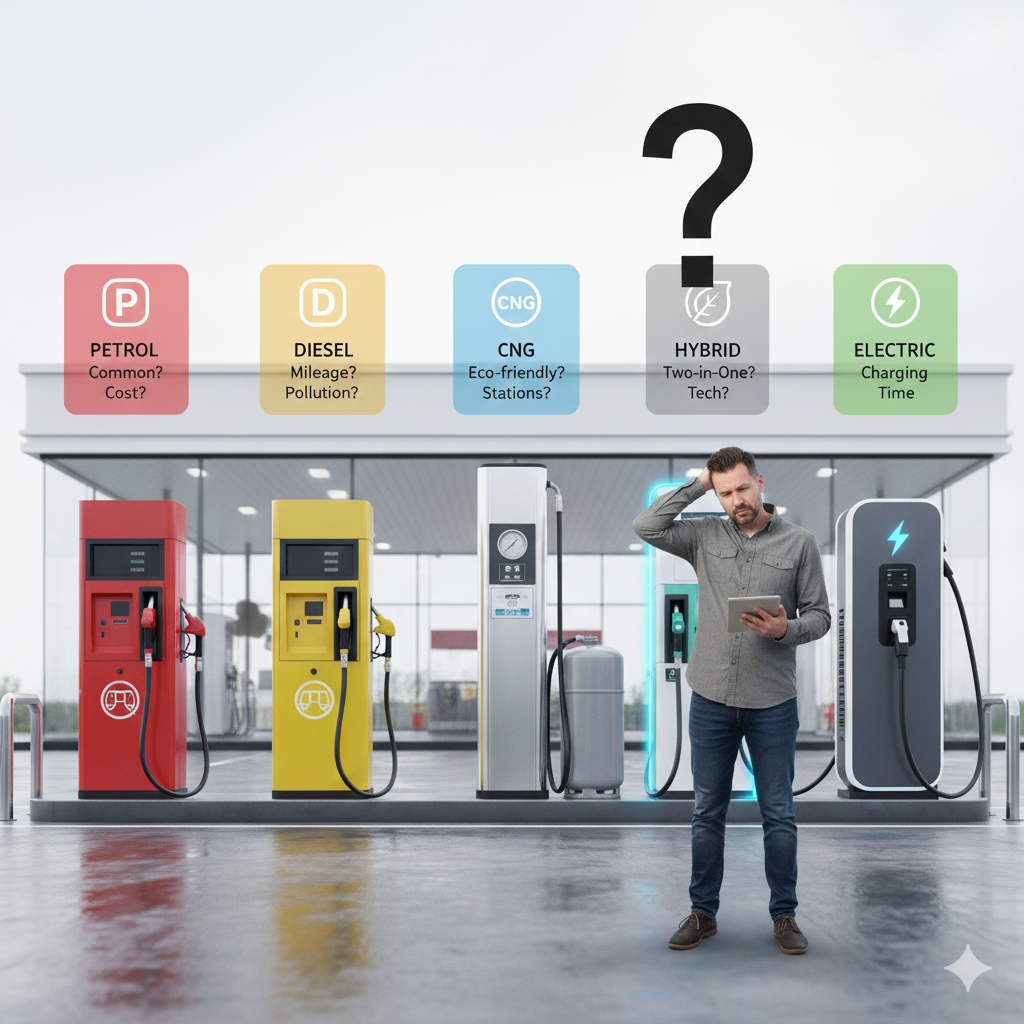
The fuel type debate has evolved far beyond the simple petrol vs diesel discussion of yesteryears. With CNG adoption surging, electric vehicles entering mainstream conversation, and hybrid technology making inroads, Indian car buyers face a more complex decision than ever before. Your choice of fuel doesn’t just affect your monthly fuel bills—it fundamentally impacts your car’s performance, maintenance costs, resale value, and even your daily driving experience.
Here’s a reality check: choosing the wrong fuel type can cost you ₹2-3 lakhs over five years of ownership. Yet most buyers make this crucial decision based on incomplete information or outdated thumb rules. Let’s dive deep into each fuel option, armed with real numbers and practical insights that go beyond showroom sales pitches.
1. Petrol: The Default, Low-Mileage Choice
Best For: Driving under 15,000 km/year. Mostly city use.
The Pro-Con: Lower purchase price (₹1-1.5 Lakh less than diesel) and quieter, smoother drive. But, your running cost is the highest (roughly ₹4-5/km).
The Bottom Line: Simplest to own. If your usage is low, the petrol variant’s cheaper price saves you more than the others save on fuel.
2. Diesel: The Highway & High-Mileage Champion
Best For: Driving over 20,000 km/year. Frequent highway travel.
The Pro-Con: Excellent efficiency and great torque for overtaking. However, you pay a steep ₹1-1.5 Lakh premium upfront and face higher maintenance (like DPF filter issues, which can cost ₹15,000+).
The Bottom Line: The Break-Even Point is around 5 years (or 80,000 – 1,00,000 km). If you sell before then, you lost money. Avoid in NCR due to the 10-year age limit.
3. CNG: The Budget King
Best For: Maximum savings on running cost (as low as ₹1.5-2/km). Daily, fixed-route city commuters with reliable pump access.
The Pro-Con: Unbeatable running costs. The Payback Period for the extra upfront cost is super-fast: just over 1 year. But, you lose 60-70% of your boot space, face power loss, and sometimes long refuelling queues.
The Bottom Line: The smartest choice purely for running costs, provided you can live with the practical compromises and have good city infrastructure.
4. Electric (EV): The Urban Future
Best For: Zero-stress daily commutes under 150 km. Owners with guaranteed home charging.
The Pro-Con: Near-zero running cost (under ₹1/km) and minimal maintenance. High initial price (₹5-10 Lakh premium) is the main barrier, plus concerns over battery replacement costs (₹5-8 Lakh) after 8+ years.
The Bottom Line: A future-proof investment, but only if you have the budget and a reliable way to charge at home or work.
Quick Decision Matrix
| Your Need | Fuel Type | Why? |
| Drive < 15,000 km/year | PETROL | Lowest purchase price; refinement beats fuel savings. |
| Drive > 20,000 km/year | DIESEL | Worth the premium and complex maintenance for high mileage. |
| Lowest running cost is #1 | CNG | Fastest ROI (about 15 months) despite space/power loss. |
| Daily commute < 150 km + Home Charging | ELECTRIC | Best long-term running cost and minimal hassle. |
Maintenance Cost Reality
Annual maintenance varies significantly:
- Petrol: ₹15,000-20,000 (regular services)
- Diesel: ₹20,000-30,000 (includes DPF maintenance)
- CNG: ₹18,000-25,000 (includes kit servicing)
- Electric: ₹8,000-12,000 (minimal mechanical parts)
Resale Value Considerations
After 5 years and 75,000 km:
- Petrol: Retains 50-55% value
- Diesel: Retains 55-60% in SUVs, 45-50% in sedans
- CNG: Retains 45-50% (strong in commercial segment)
- Electric: Unknown (estimated 40-45%)
The CarQ Advantage: Fuel-Type Intelligence
When buying a used car, fuel type dramatically affects what you need to verify. This is where CarQ’s specialized reports become invaluable.
Critical Checks by Fuel Type
For Diesel Vehicles: CarQ’s vehicle history reports reveal crucial diesel-specific maintenance:
- DPF cleaning records (skipped DPF cleaning = ₹50,000 repair)
- Turbocharger service history
- Injector replacement records
- AdBlue system maintenance (BS6 models)
For CNG Vehicles: Our inspection service specifically verifies:
- Kit installation quality and certification
- Cylinder testing compliance
- Pressure regulator condition
- Safety valve functionality
- Sequential vs venturi kit identification
For Electric Vehicles: CarQ’s specialized EV inspection includes:
- Battery health percentage
- Charging cycle count
- Cell balance reports
- Warranty status verification
- Fast-charging impact assessment
For Petrol Vehicles: Standard but critical checks:
- Carbon buildup in direct injection engines
- Spark plug replacement history
- Timing chain/belt service
- Fuel pump health in turbo variants
Quick Decision Tree: Which Fuel Type Is Right For You?
START HERE: How many kilometers do you drive per month?

├─ "Less than 1,200 km/month (15,000 km/year)"
│  ├─ Mostly city driving? → PETROL ✓ (simplest, most economical for low usage)
│  └─ Want lowest running costs? → CNG ✓ (saves money even with low usage)
│
├─ "1,200-1,700 km/month (15,000-20,000 km/year)"
│  ├─ Mostly city with good CNG pumps? → CNG ✓ (best economics)
│  ├─ Want smooth, hassle-free? → PETROL ✓ (good balance)
│  └─ Lots of highway driving? → DIESEL ✓ (starts making sense)
│
├─ "More than 1,700 km/month (20,000+ km/year)"
│  ├─ Mostly city + CNG pumps available? → CNG ✓ (maximum savings)
│  ├─ Mostly highway/long trips? → DIESEL ✓ (best efficiency + power)
│  └─ Mix of city + highway? → DIESEL ✓ (worth the premium now)
│
└─ "Specific daily commute under 150 km + home parking"
   ├─ Have home charging access? → ELECTRIC ✓ (lowest running cost)
   └─ No charging access? → CNG or PETROL

SPECIAL CONSIDERATIONS:

💰 BUDGET-CONSCIOUS?
├─ High daily usage? → CNG (lowest per-km cost)
└─ Low-moderate usage? → Petrol (lowest upfront cost)

🏙️ LIVE IN NCR/DELHI?
└─ Avoid Diesel → 10-year age ban means poor resale value

🚗 BUYING SUV?
└─ High mileage user? → Diesel holds better resale value in SUVs

🔌 ECO-CONSCIOUS + TECH-SAVVY?
├─ Can charge at home? → Electric (future-ready)
└─ No charging? → CNG or Hybrid

⚠️ QUICK CHECKS:
✓ CNG user? Check pump locations on your regular routes
✓ EV user? Verify charging at home/office is possible
✓ Diesel user? Ready for louder engine + higher service costs?
✓ Petrol user? Comfortable with higher fuel bills?
The Used Car Buyer’s Alert
Fuel type verification becomes critical in the used car market. A diesel with incomplete DPF service history is a ticking time bomb. A CNG car with an unauthorized kit installation is both illegal and dangerous. An EV with 40% battery degradation means imminent replacement costs exceeding ₹5 lakhs.
This is where CarQ’s comprehensive vehicle history reports prove invaluable. Our reports don’t just show service records—they analyze them for fuel-type-specific red flags. We identify missed DPF cleanings in diesels, verify CNG kit authenticity, and for EVs, provide battery health assessments that could save you lakhs.
Our AI-powered insights predict upcoming fuel system maintenance based on your chosen vehicle’s history. That seemingly cheap diesel might need injector replacement next month (₹80,000). The CNG variant might have cylinder re-testing due (₹5,000). These hidden costs often exceed any fuel savings you hoped to achieve.
Conclusion: Calculate, Don’t Speculate
The fuel type decision extends far beyond simple mileage mathematics. It affects your daily driving experience, long-term ownership costs, and eventual resale value. While that diesel’s torque might feel great during test drives, calculate if you’ll actually drive enough to justify the premium. That CNG’s running costs look attractive, but factor in the convenience compromise.
Most importantly, in the used car market, never trust fuel type claims without verification. Converted CNG vehicles, deleted DPF diesels, and degraded EV batteries are common profit traps for unsuspecting buyers.
Ready to make an informed choice? Start by checking your vehicle’s basic details, then get a comprehensive CarQ vehicle history report for your shortlisted vehicle. Our fuel-type-specific analysis reveals maintenance patterns, predicts upcoming costs, and identifies potential issues that generic inspections miss. For complete peace of mind, schedule a professional used car inspection to verify every fuel system component. Don’t let the wrong fuel type burn a hole in your pocket—verify before you buy.
Get Your CarQ Vehicle History Report →
Coming Up Next in the Series:
“Set a Budget – And Plan for More Than Just the Price Tag”
Think beyond the on-road price—include running costs, service, and future repairs in your budget plan
Pingback: From Confused to CarQ’ed – CarQ – Smarter Used Car Decisions
Pingback: Your Complete Guide to Car Body Types: Pros, Cons & Best Use Cases – CarQ – Smarter Used Car Decisions