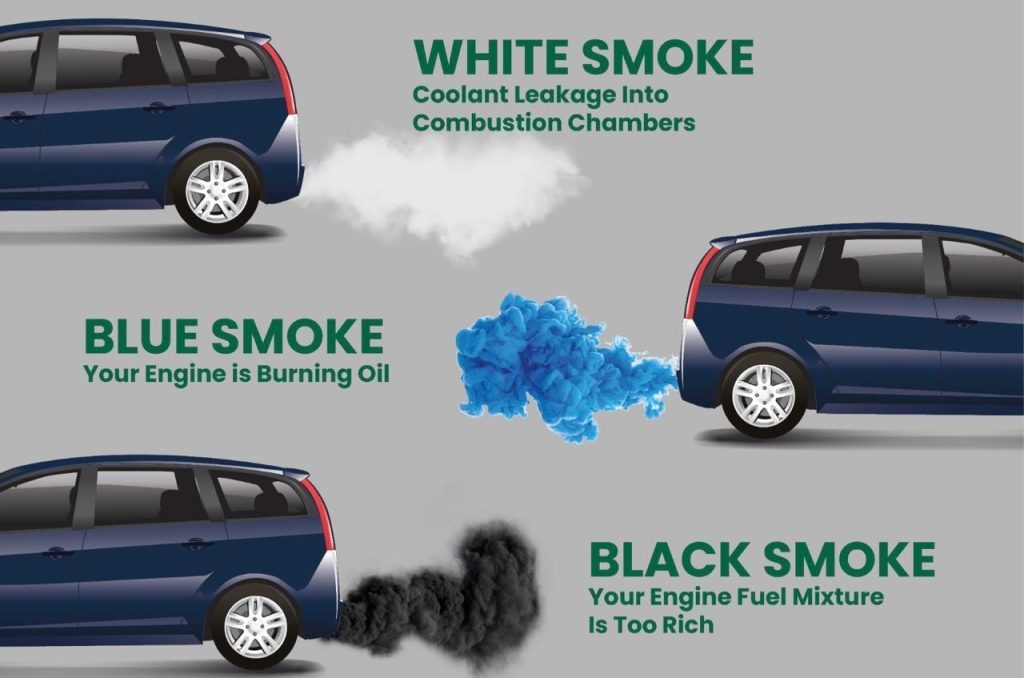
Blue smoke, black smoke, white smoke—each color reveals a different ₹40,000-1,50,000 engine problem.
The exhaust system does more than muffle noise. It reduces emissions, improves efficiency, and most importantly, reveals engine health. Smoke color, smell, sound, and visible damage tell stories: worn piston rings (₹60,000 repair), blown head gasket (₹50,000), or catalytic converter failure (₹25,000). Sellers time test drives to avoid cold starts (when smoke is worst) and hope you don’t look under the car.
The trap: Warm engine = clean exhaust. Seller avoided cold start, you miss the blue smoke revealing oil consumption.
What you’ll learn:
- Smoke color diagnosis (blue, black, white)
- Sound analysis (leaks, damaged muffler)
- Catalytic converter failure detection
- Underbody inspection (rust, damage, leaks)
- When exhaust issues mean engine failure
Section 1: Smoke Color Diagnosis
White smoke:
Light white (first 30 seconds after cold start):
- Normal: Condensation burning off
- Goes away quickly
Thick white smoke (continues >1 minute):
- Cause: Coolant entering combustion chamber
- Why: Blown head gasket, cracked cylinder head
- Smell: Sweet (coolant)
- Repair cost: ₹40,000-80,000
Blue/gray smoke:
Appearance: Blue-tinted smoke, especially on acceleration or deceleration
Cause: Engine oil burning
- Worn piston rings
- Worn valve seals
- Turbo seal failure (turbo cars)
Smell: Burnt oil
Repair cost:
- Valve seals: ₹25,000-40,000
- Piston rings: ₹60,000-1,00,000
- Turbo: ₹80,000-1,50,000
Black smoke:
Appearance: Dark gray to black soot
Cause: Rich fuel mixture (too much fuel, not enough air)
- Faulty fuel injectors
- Air filter clogged
- MAF sensor failure
- Turbo over-boosting
Repair cost: ₹5,000-25,000 (depending on cause)
Less severe than blue/white, but indicates poor fuel economy + emissions failure
Section 2: Cold Start Test (Critical)
Why cold start matters:
- Engine seals tightest when cold
- Smoke most visible when engine cold
- Sellers avoid cold starts to hide smoke
How to insist on cold start:
When scheduling inspection:
- “Please don’t start the car before I arrive”
- Arrive early (before agreed time if needed)
- Feel hood: Should be cold to touch
If seller “warmed it up for you”:
- Red flag: They’re hiding something
- Insist on waiting 2-3 hours, return for cold start test
- Or walk away (lack of transparency)
Cold start observation:
- Start engine
- Immediately observe exhaust
- Watch for first 30-60 seconds
- Normal: Light white smoke (condensation) for 10-20 seconds, then clear
- Problem: Blue, black, or thick white smoke continuing >30 seconds
Section 3: Exhaust Sound Analysis
Normal exhaust sound:
- Smooth, consistent tone
- Slightly louder on acceleration, quieter at idle
Problem sounds:
1. Loud, roaring sound:
- Cause: Exhaust leak (manifold crack, pipe hole, muffler damage)
- Also: Rattling (loose heat shield)
- Repair cost: ₹3,000-15,000 (depending on location)
2. Ticking/tapping (from engine bay):
- Cause: Exhaust manifold crack (leak near engine)
- Worsens when cold, may reduce when warm
- Repair cost: ₹8,000-25,000
3. Hissing:
- Cause: Small leak in pipe or gasket
- Repair cost: ₹2,000-8,000
4. Popping/backfiring:
- Cause: Fuel mixture issue, ignition timing, exhaust leak
- Indicates: Engine tuning problem or damage
- Diagnosis + repair: ₹5,000-20,000
Section 4: Catalytic Converter Failure
What catalytic converter does:
- Converts toxic gases (CO, NOx, HC) to less harmful (CO2, H2O, N2)
- Required for emissions compliance (PUC test)
Symptoms of failure:
1. Sulfur smell:
- Rotten egg odor from exhaust
- Indicates: Converter breaking down
2. Reduced performance:
- Clogged converter restricts exhaust flow
- Engine feels sluggish, won’t rev freely
3. Rattling sound:
- Internal catalyst substrate broken (loose inside)
- Rattle heard when starting or accelerating
4. Check Engine light:
- OBD code P0420/P0430: Catalyst efficiency below threshold
Replacement cost:
- ₹15,000-40,000 (depending on car)
- Premium cars: ₹40,000-80,000
Temporary fix scams:
- Some mechanics “gut” the converter (remove internals)
- Passes visual inspection but fails emissions
- Illegal + resale problems
Section 5: Underbody Exhaust Inspection
If lift available (or ramp, inspection pit):
Check for:
1. Rust/corrosion:
- Surface rust: Normal (especially 5+ years old)
- Holes, perforation: Problem (exhaust leak, ₹3,000-10,000 repair)
2. Physical damage:
- Dents, bends (from speed bumps, rocks)
- Problem: Restricted flow (performance loss)
3. Aftermarket modifications:
- Modified exhaust (louder, may be illegal)
- Removed catalytic converter (illegal, emissions fail)
- See Blog #29 for modification implications
4. Hangers/brackets:
- Rubber hangers hold exhaust in place
- Broken hangers: Exhaust hangs low, drags on ground
- Repair cost: ₹500-2,000
5. Fresh welds/patches:
- Indicates: Recent exhaust repair
- Ask seller: Why was repair needed? (accident? rust?)
Section 6: Emissions and PUC Test
PUC (Pollution Under Control) certificate:
- Required every 6 months
- Tests: CO, HC, smoke opacity (diesel)
Check seller’s PUC:
- Valid: Dated within last 6 months
- Expired: Car may not pass retest (₹500-1,500 for test + potential repairs)
If car fails PUC:
Common causes:
- Catalytic converter failure (₹15,000-40,000)
- Engine tuning issues (₹3,000-10,000)
- Oxygen sensor failure (₹4,000-8,000)
If seller’s PUC is expired/missing:
- Demand: Fresh PUC before purchase
- Or: Negotiate discount for PUC + potential repairs
Section 7: Real Case – The Blue Smoke Special
2019 Hyundai Venue, 60,000 km, asking ₹8,80,000
Seller warmed engine before showing:
- Test drive: Exhaust looked clean
- No visible smoke
Buyer suspicious (engine already warm at 9 AM):
Buyer’s request:
- “Let’s turn off engine, wait 30 minutes, restart”
Seller’s response:
- “Why? Engine is fine, you already saw it run”
- Buyer insisted
Cold start test (30 minutes later):
- Started engine
- Thick blue smoke poured out for 45 seconds
- Gradually reduced but still visible
Diagnosis: Oil consumption (piston rings or valve seals)
Seller confronted:
- “That’s just normal cold start smoke” (lie)
- Shown video of excessive blue smoke
Seller admitted:
- “I add 1L oil every 5,000 km”
- “Dealer said it’s acceptable consumption” (misleading)
Repair estimate:
- Piston ring replacement: ₹70,000-1,00,000
- Or: Drive with ongoing oil consumption (₹1,500/5,000 km)
Negotiation:
- Buyer demanded ₹1,00,000 discount
- Seller refused
- Buyer walked away
Lesson: Insist on cold start. Warm engine hides smoke.
Conclusion: Exhaust Speaks Truth
What comes out reveals what’s inside. Listen, look, and smell carefully.
Your protocol:
Cold start (mandatory, 5 minutes):
- Insist engine cold
- Observe exhaust immediately upon starting
- Watch for 60 seconds
Sound analysis (during test drive, 10 minutes):
- Listen for leaks, rattles, unusual sounds
- Test across RPM range
Underbody inspection (if possible, 5 minutes):
- Check for rust, damage, leaks
- Verify catalytic converter present
PUC verification (1 minute):
- Check certificate validity
Decision framework:
- No smoke, normal sound, valid PUC: Proceed
- Black smoke (rich mixture): Negotiate ₹5,000-10,000 discount
- Blue smoke (oil consumption): Demand ₹50,000-1,00,000 discount OR walk away
- White smoke (coolant burning): Walk away (head gasket, expensive repair)
- Seller refuses cold start: Walk away (hiding problems)
Exhaust doesn’t lie. Make sure you see what it’s saying.
Key Takeaways
✓ Blue smoke = oil burning (rings, seals, turbo – ₹25-100K repair)
✓ White smoke (thick, continuous) = coolant burning (head gasket – ₹40-80K)
✓ Black smoke = rich fuel mixture (injectors, sensors – ₹5-25K)
✓ Cold start reveals true condition (sellers warm engine to hide smoke)
✓ P0420/P0430 codes = catalytic converter failure (₹15-40K replacement)
✓ Rotten egg smell = catalyst breaking down (replacement needed)
✓ Insist on cold start (seller refusal = red flag, walk away)
Checklist References
- exterior#25: Exhaust smoke color (cold start test)
- exterior#84: Exhaust system visual inspection
- engine#26: Exhaust manifold condition
- obd_scan#5: Emissions-related codes (P0420-P0430)
Related Reading:
Next Steps
Professional exhaust + emissions testing → Cold start observation, OBD scan, PUC verification
Check service history for exhaust repairs → Previous catalytic converter or manifold replacements
Blue smoke doesn’t mean “character.” It means ₹70,000 in engine repairs.