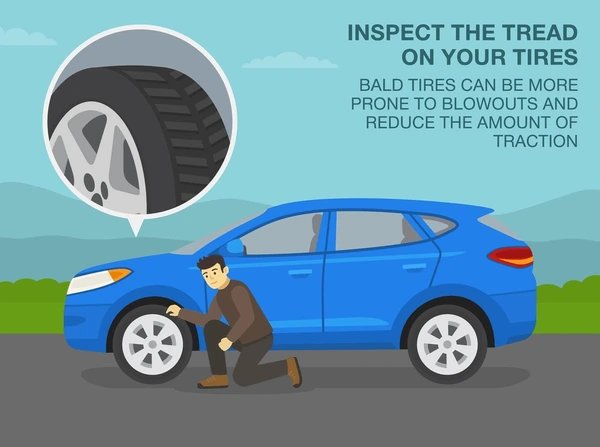
Those “barely used” tires with 80% tread? The wear pattern says they’re from a car that pulls left, has worn suspension, and needs ₹30,000 in alignment work.
Tires don’t just wear down—they tell stories. Even tread across all four tires means proper maintenance. Uneven wear screams neglect: misalignment, worn suspension, improper inflation. Sellers show you tread depth (looks good!), hiding the wear patterns that reveal expensive mechanical problems. You buy the car, discover the alignment issue, and pay ₹25,000-40,000 for suspension repairs the seller knew about.
The fraud: Seller rotates front worn tires to rear (hiding edge wear), shows you “good tread depth,” you discover alignment problems after purchase.
What you’ll learn:
- Tire wear patterns (what each reveals)
- Tread depth measurement (legal minimum, safe minimum)
- Manufacturing date reading (DOT code)
- When mismatched tires indicate accidents
- How tire condition predicts ₹30,000 in hidden repairs
Section 1: How to Read Tire Manufacturing Date
Every tire has a DOT code:
Location: Tire sidewall, near rim
Format: DOT XXXX XXXX 2319
- Last 4 digits = manufacturing date
- 23 = week (23rd week of year)
- 19 = year (2019)
Example:
- DOT code: 2319 = Manufactured in June 2019
Why it matters:
Rubber degrades with age:
- 0-3 years: Optimal
- 3-5 years: Good (if stored properly)
- 5-7 years: Marginal (cracks may appear)
- 7+ years: Replace (rubber hardened, reduced grip, blowout risk)
Red flags:
1. Mismatched ages:
- Front tires: 2021
- Rear tires: 2017
- Indicates: Front tires replaced (why? accident? alignment issue caused premature wear?)
2. All tires very old (7+ years):
- Seller neglected basic maintenance
- Risk: Blowout, reduced braking performance
3. New tires on old car:
- 2015 car, tires manufactured 2024
- Could be: Seller preparing to sell (hid wear issues with new tires)
- Check: Why were old tires replaced? Accident? Alignment damage?
Section 2: Tread Depth Measurement
Legal minimum (India): 1.6mm
Safe minimum: 3mm (especially for monsoon)
How to measure:
Method 1: Tread depth gauge (₹200-500)
- Insert probe into tread groove
- Read measurement
- Check: Multiple points across tire width, all four tires
Method 2: Coin test (quick check)
- Insert ₹5 coin into tread groove (edge first)
- If tread doesn’t cover outer band of coin = below 2mm (replace soon)
Interpretation:
Uniform depth (all points similar):
- Example: 6mm across entire tire, all four tires
- Indicates: Proper maintenance, alignment good
Uneven depth:
- Example: Inner edge 3mm, outer edge 7mm
- Indicates: Alignment issue, suspension problem
Section 3: Tire Wear Patterns (What They Reveal)
Pattern 1: Center wear (middle worn more than edges)
Appearance: Bald strip down center, edges have tread
Cause: Overinflation
- Tire inflated above recommended PSI
- Center bulges, contacts road more
Cost impact:
- Tires: Replace soon (₹12,000-30,000 for set of 4)
- Root cause: Seller likely overinflated to reduce rolling resistance (fuel economy), accelerated tire wear
Pattern 2: Edge wear (both edges worn, center has tread)
Appearance: Bald edges, center good tread
Cause: Underinflation
- Tire pressure too low
- Edges flex more, wear faster
Cost impact:
- Tires: Replace soon (₹12,000-30,000)
- Also check: Why underinflated? TPMS not working? Slow leak? Seller negligence?
Pattern 3: One-sided wear (inner OR outer edge worn)
Appearance: Inner edge bald (3mm), outer edge good (7mm)
Cause: Wheel misalignment (camber/toe incorrect)
Cost impact:
- Tires: Replace (₹12,000-30,000)
- Alignment: ₹2,000-4,000
- Suspension repair: ₹15,000-40,000 (if worn ball joints, bushings caused misalignment)
This is the BIG red flag—indicates deferred suspension maintenance
Pattern 4: Cupping/scalloping (wavy wear pattern)
Appearance: High and low points around tire circumference (feels bumpy)
Cause:
- Worn shock absorbers (tire bounces)
- Unbalanced wheels
- Worn suspension bushings
Cost impact:
- Tires: Replace (₹12,000-30,000)
- Shock absorbers: ₹8,000-20,000 (set of 4)
- Wheel balancing: ₹1,000-2,000
- Suspension bushings: ₹10,000-25,000
Total potential cost: ₹30,000-75,000
Pattern 5: Feathering (tread ribs rounded on one side)
Appearance: Run hand across tread—feels smooth one direction, sharp the other
Cause: Toe misalignment (wheels pointing in/out)
Cost impact:
- Tires: Replace (₹12,000-30,000)
- Alignment: ₹2,000-4,000
- Possible steering component wear: ₹8,000-20,000
Pattern 6: Flat spots (localized bald patches)
Appearance: One or more flat, bald sections
Cause:
- Hard braking (wheels locked, tire skidded)
- Parking with flat tire (weight on one spot)
Indicates:
- Emergency braking incident (possible accident)
- Or: ABS failure (wheels locked during braking)
Cost impact:
- Tire replacement: ₹3,000-8,000 per tire
- If ABS issue: ₹15,000-40,000 (see Blog #46)
Section 4: Tire Brand and Quality Mismatches
Ideal: All four tires same brand, model, size
Red flags:
1. Different brands on each wheel:
- Front left: MRF
- Front right: Apollo
- Rear left: CEAT
- Rear right: JK Tyre
Indicates:
- Seller replaced tires individually (cheapest available)
- Possible accident damage (replaced damaged tire only)
Problem:
- Different grip levels (handling imbalance)
- Different wear rates
2. Budget tires on premium car:
- Car: 2020 BMW 3 Series (₹45 lakh car)
- Tires: Low-end brand (₹3,000 per tire vs ₹12,000 OEM-spec)
Indicates:
- Cost-cutting on critical safety component
- Likely: Other maintenance also neglected
3. Mismatched sizes:
- Front: 195/65 R15
- Rear: 205/60 R15 (different size)
Problem:
- Speedometer error
- Handling imbalance
- Indicates: Seller used wrong tires (lack of knowledge or care)
Section 5: Sidewall Inspection
Check for damage:
1. Cracks:
- Small surface cracks: Normal if 5+ years old
- Deep cracks (>2mm): Tire failure risk, replace
2. Bulges/bubbles:
- Appearance: Bump on sidewall
- Cause: Impact (pothole, curb), internal structure damaged
- Risk: Blowout imminent
- Action: Reject car OR demand immediate tire replacement
3. Cuts/punctures:
- Sidewall cut >5mm: Unrepairable, replace tire
4. Curb rash:
- Appearance: Scuff marks, rubber scraped off
- Indicates: Careless parking, possible wheel damage too
5. Tire plugs (in sidewall):
- Appearance: Rubber plug visible
- Problem: Sidewall plugs are unsafe (tire cords damaged)
- Action: Demand tire replacement
Section 6: Spare Tire Verification
Check spare tire condition:
1. Type:
- Full-size spare: Same size as other tires (good)
- Space-saver (donut): Smaller, temporary (acceptable)
- Repair kit only: No spare (some modern cars)
2. Condition (if full-size spare):
- Tread depth: Should be good (rarely used)
- Age: Check DOT code (if >10 years, replace)
3. Inflation:
- Spare should be inflated (check with gauge)
- Common: Spare flat from sitting unused
- Cost to inflate: Free at petrol pump
4. Matching specification:
- Spare should be same size as other tires
- Red flag: Different size spare (won’t fit if needed)
Section 7: Tire Replacement Costs (Negotiation Baseline)
If tires need replacement soon (<3mm tread or wear issues):
Hatchback (175/65 R14 or 185/65 R15):
- Budget tires: ₹3,000-4,500 per tire
- Mid-range (Apollo, MRF): ₹4,500-6,500 per tire
- Set of 4: ₹12,000-26,000
Sedan (195/65 R15 or 205/55 R16):
- Mid-range: ₹5,500-7,500 per tire
- Premium (Michelin, Bridgestone): ₹7,500-10,000 per tire
- Set of 4: ₹22,000-40,000
SUV (235/60 R18 or larger):
- Mid-range: ₹8,000-12,000 per tire
- Premium: ₹12,000-18,000 per tire
- Set of 4: ₹32,000-72,000
Add: Alignment (₹2,000-4,000), balancing (₹1,000-2,000)
Section 8: Real Case – The “Good Tread” Deception
2019 Honda City, 65,000 km, asking ₹10,20,000
Seller’s claim: “Tires almost new, 80% tread remaining”
Buyer’s tread depth check:
- All four tires: 6-7mm depth (appears good)
But buyer checked wear pattern:
Front tires:
- Inner edge: 3mm tread
- Outer edge: 8mm tread
- Severe one-sided wear
Rear tires:
- Cupping pattern (wavy, bumpy feel)
Red flags triggered
Buyer’s investigation:
Test drive:
- Car pulled slightly right
- Steering wheel off-center (1 o’clock position when driving straight)
- Confirms: Alignment issue
Underbody inspection:
- Right front: Ball joint worn (play visible)
- Shock absorbers: Leaking oil (front right)
Diagnosis:
- Ball joint wear caused misalignment
- Worn shock caused cupping
- Seller never addressed root cause, just drove with bad alignment
Repair estimate:
- 4 new tires: ₹25,000 (mid-range)
- Ball joint replacement: ₹8,000
- Front shock absorbers: ₹12,000
- Wheel alignment: ₹3,000
- Total: ₹48,000
Negotiation:
- Buyer demanded ₹55,000 discount (repair cost + deferred maintenance penalty)
- Seller countered: “Tires have good tread, only ₹20,000 off”
Buyer’s response:
- Showed photos of wear patterns, explained suspension issues
- “Tread depth means nothing when wear is uneven and suspension is worn”
Outcome:
- Seller agreed to ₹45,000 discount
- Final price: ₹9,75,000
Lesson: Tread depth lies. Wear pattern tells the truth.
Conclusion: Tires Talk—Listen Carefully
Four tires, four stories. Read them all before you buy.
Your inspection protocol:
Manufacturing date (2 minutes):
- Check DOT code on all four tires
- Red flag: Any tire >7 years old OR mismatched dates
Tread depth (5 minutes):
- Measure all four tires (inner, center, outer)
- Red flag: <3mm OR uneven measurements
Wear pattern analysis (5 minutes):
- Inspect each tire for center wear, edge wear, one-sided wear, cupping
- Run hand across tread (feel for feathering)
- Red flag: Any uneven wear pattern
Sidewall inspection (5 minutes):
- Check for cracks, bulges, cuts, curb rash
- Red flag: Bulges (immediate replacement needed)
Decision framework:
- All tires good condition, even wear, <5 years old: Proceed
- Tires 5-7 years old but even wear: Negotiate ₹15,000-25,000 discount
- Uneven wear patterns: Negotiate ₹40,000-60,000 (tires + alignment + suspension)
- Bulges, deep cracks, or 7+ years old: Demand tire replacement before purchase OR walk away
Tires are your only contact with the road. Make sure they’re telling good stories.
Key Takeaways
✓ DOT code last 4 digits = week + year of manufacture (tires >7 years old = replace)
✓ One-sided wear = alignment issue + suspension wear (₹25-50K in repairs)
✓ Cupping wear = worn shocks or bushings (₹30-75K repair cost)
✓ Tread depth >3mm needed for monsoon safety (legal 1.6mm too low)
✓ Mismatched tire brands = patchwork replacement (indicates accidents or neglect)
✓ Sidewall bulges = blowout risk (demand immediate replacement)
✓ Tire wear reveals deferred maintenance (seller saved ₹30K, you inherit the cost)
Checklist References
- exterior#18: Tire tread depth measurement
- exterior#19: Tire wear pattern analysis
- exterior#87: Tire manufacturing date check (DOT code)
- exterior#101: Spare tire condition
- under_body#8: Suspension component wear (causes tire wear)
Related Reading:
Next Steps
Check service history for alignment and tire replacements → Reveals suspension issues
Professional tire + suspension inspection → Wear pattern analysis, alignment check, shock absorber testing
Good tread depth doesn’t mean good tires. Check the wear pattern—it never lies.