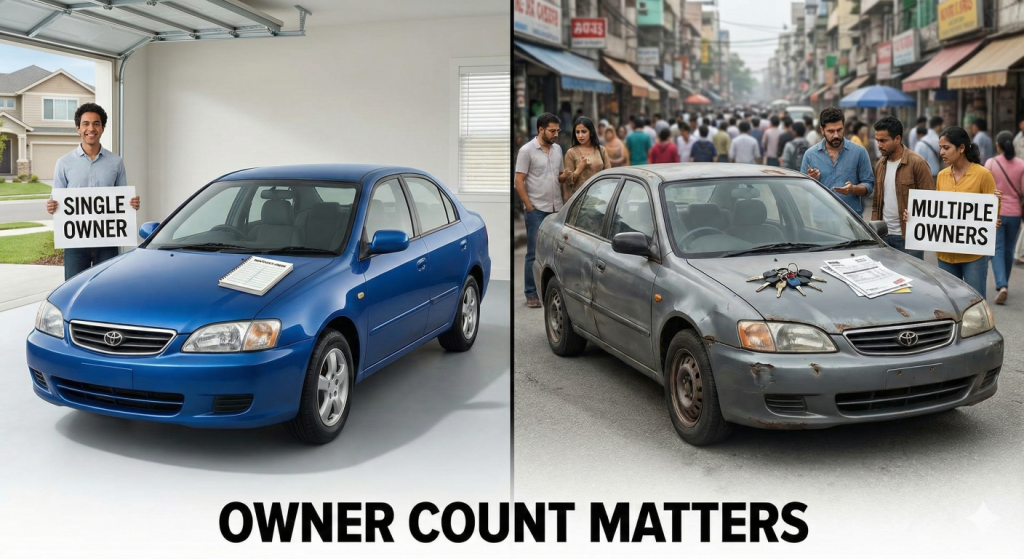
“First owner, never sold”—the golden phrase that adds ₹50,000-1,00,000 to value. But does it really matter, or is it marketing hype?
Single ownership signals stability: one driver, consistent maintenance, known history. Multiple ownerships within short periods raise red flags: problem car passed around, inconsistent care, possible accident history. A 5-year-old car with 4 owners averages 15 months per owner—each discovering issues and selling quickly. By the time you’re owner #5, you inherit accumulated neglect and hidden problems.
The question: Is single ownership worth paying extra, or are well-maintained multi-owner cars equally good?
What you’ll learn:
- Value difference (single vs multi-owner: 10-20% premium)
- Ownership pattern analysis (time per owner, why they sold)
- Transfer documentation verification (fake “single owner” claims)
- When multiple ownership is acceptable
- Red flags in ownership history
Section 1: Single Ownership Value Premium
Why buyers prefer single owners:
1. Consistent maintenance:
- One owner develops relationship with service center
- Follows service schedule
- Knows the car’s quirks and history
2. Driving pattern stability:
- One driver = consistent driving style
- Less wear from multiple driving habits
- Known usage (city vs highway, daily commute vs occasional)
3. Emotional care:
- First owner often has emotional attachment
- Maintains car like their own (because it is)
- Later owners see it as “temporary,” less invested in upkeep
4. Documentation completeness:
- Original invoices, service records preserved
- Owner manual, spare keys available
- No gaps in history
Value premium:
- Single owner, same make: +15-20% vs multi-owner
- Single owner, different make: +10-15%
- Example: 2019 Honda City
- Single owner: ₹10,50,000
- Third owner: ₹8,50,000-9,00,000
- Difference: ₹1,50,000-2,00,000
Section 2: Ownership Transfer Patterns (Red Flags)
Healthy ownership pattern:
Example: 2018 Maruti Swift (6 years old)
- Owner 1: 2018-2024 (6 years)
- Current listing: Second owner
- Analysis: Original owner kept car full term, normal lifecycle sale
Concerning pattern:
Example: 2020 Hyundai Creta (4 years old)
- Owner 1: 2020-2021 (1 year)
- Owner 2: 2021-2022 (1 year)
- Owner 3: 2022-2023 (1 year)
- Owner 4: 2023-2024 (1 year)
- Current listing: Fifth owner
- Analysis: Problem car, each owner discovers issues and dumps it quickly
Why rapid ownership changes happen:
1. Problem vehicle:
- Hidden accident damage discovered post-purchase
- Mechanical issues emerge (transmission failure, engine problems)
- Owner sells to avoid expensive repairs
2. Financial stress:
- Owner took loan, couldn’t afford EMI
- Forced quick sale
3. Dealer flipping:
- Dealer buys, registers in their name, sells
- Appears as “ownership change” but not real user change
Red flag thresholds:
<2 years per owner = High risk
- Example: 4-year car with 3+ owners
- Each owner kept <16 months = something wrong
2-3 years per owner = Moderate concern
- Not ideal, but explainable
- Verify reason for each sale
>3 years per owner = Normal
- Reasonable ownership duration
- Lower risk
Section 3: How to Verify Ownership History
RC (Registration Certificate) check:
What RC reveals:
1. Registration date:
- Original registration date (first owner start)
2. Current owner name:
- Must match seller’s ID exactly
- Mismatch = unauthorized sale
3. Transfer history (some states):
- Some RTOs show number of previous owners
- Not all states provide this detail
Online RTO portals:
Vahan/Parivahan:
- Enter registration number
- May show: “Number of owners” (if state provides)
- Example: “Second Owner” or “Third Owner”
Limitations:
- Not all states update owner count
- Some show only current owner
Insurance records:
How insurance reveals ownership:
1. Policy holder name history:
- Each ownership transfer requires insurance transfer
- Insurance company records show: Previous policy holders
- Request: Insurance claim history (via CarQ) shows all policy holders since registration
2. NCB (No Claim Bonus) transfer:
- NCB belongs to owner, not car
- If car sold, NCB doesn’t transfer
- New owner starts at 0% NCB
- If policy shows NCB: Current owner held car long enough to accumulate (2+ years)
Form 29/30 (Transfer forms):
What to request from seller:
Form 29: Notice of transfer BY seller (previous transaction)
- If current owner is “second owner,” they should have Form 29 from first owner
- Dated: Shows when transfer occurred
- Confirms: Previous owner identity, transfer date
Form 30: Application for transfer BY buyer (current owner when they bought)
- Shows current owner’s purchase date
Analysis:
- If transfer forms missing: Seller may be lying about ownership count
- If dates don’t align with claimed timeline: Fraud
CarQ vehicle history report:
What’s included:
- Ownership count verification
- Transfer dates
- Insurance policy holder history
- Cross-references: RC, insurance, RTO records
Section 4: When Multiple Ownership Is Acceptable
Not all multi-owner cars are bad. Some scenarios are fine:
Scenario 1: Dealer intermediate ownership
Pattern:
- Owner 1: 2018-2023 (5 years)
- Owner 2 (dealer): 2023-2023 (2 months)
- Owner 3: 2023-2024 (current)
Analysis:
- First owner kept 5 years (good)
- Dealer briefly owned for resale (normal)
- Not a problem – original owner held appropriately
How to detect:
- Check Owner 2 name on RC: Often company name (dealer)
- Transfer date close to current listing date
Scenario 2: Relocation/job change
Example:
- Owner 1: 2019-2022 (3 years) – Transferred from Mumbai to Bangalore
- Owner 2: 2022-2024 (2 years) – Current seller relocating abroad
Analysis:
- Each owner kept reasonable duration
- Legitimate reasons for sale
How to verify:
- Ask seller why previous owner sold
- Cross-check: RC address changes, service center location changes
Scenario 3: Upgrade/family expansion
Example:
- Owner 1: Bought sedan, had baby, needed SUV (sold after 2.5 years)
- Owner 2: Current seller, upgrading to luxury car (after 3 years)
Analysis:
- Normal lifecycle reasons
- Duration acceptable
Scenario 4: Well-maintained multi-owner car
Even with 3-4 owners, if:
- Complete service records from all ownerships
- No accident history
- Mechanical condition excellent
- Each owner kept 2+ years
Then: Acceptable, but negotiate 10-15% discount vs single owner
Section 5: Fake “Single Owner” Claims
How sellers fake single ownership:
Fraud technique 1: Family member registration
Setup:
- Car bought by Father (original owner)
- Transferred to Son after 2 years (second owner)
- Son sells as “single owner family car”
Detection:
- Check RC transfer date vs registration date
- Ask: “Are you the original buyer?” (not just “owner”)
- Request original purchase invoice (name should match RC)
Fraud technique 2: No RC transfer between dealers
Setup:
- Dealer buys car, doesn’t transfer RC to their name (saves fees)
- Sells directly to new buyer
- Buyer becomes “second owner” on paper, thinks they’re first
Detection:
- Original invoice vs current RC name
- Invoice dated 2020, RC still shows original 2020 owner, current year 2024 = car was sold before but not transferred
Fraud technique 3: Backdated transfer
Setup:
- Seller delays RC transfer by 6-12 months
- Makes ownership duration appear longer
Example:
- Actual ownership: Jan 2023 – Dec 2023 (12 months)
- RC transfer processed: June 2024 (6 months delay)
- Appears as: Jan 2023 – June 2024 (18 months)
Detection:
- Check insurance transfer date (must match ownership transfer)
- Service records: If last service under previous owner was Dec 2023, but RC shows transfer in June 2024 = gap fraud
Section 6: Ownership and Resale Value Calculation
How to calculate fair value adjustment:
Base value (single owner): ₹10,00,000
Adjustment factors:
Second owner (well-documented):
- If first owner kept >3 years: -5% (₹9,50,000)
- If first owner kept <2 years: -15% (₹8,50,000)
Third owner:
- If average >2 years per owner: -10% (₹9,00,000)
- If average <2 years per owner: -20% (₹8,00,000)
Fourth+ owner:
- -20% minimum (₹8,00,000)
- Consider walking away unless exceptional condition + very low price
Additional factors:
Complete service records from all owners: +5%
Missing records from any owner: -5%
Known accident history: -10-20% additional
Dealer intermediate ownership (short duration): No penalty
Example calculation:
2019 Honda Amaze VX, asking ₹7,50,000
Ownership history:
- Owner 1: 2019-2021 (2 years)
- Owner 2: 2021-2023 (2 years)
- Owner 3: 2023-2024 (current, 1 year)
Analysis:
- Third owner
- Average 2 years per owner (acceptable)
- Service records available from Owner 1 and 2, missing from Owner 3
Single-owner market value: ₹8,50,000
Adjustments:
- Third owner (average >2 years): -10% = ₹7,65,000
- Incomplete records: -5% = ₹7,26,750
Fair offer: ₹7,25,000
Seller asking: ₹7,50,000
Negotiation target: ₹7,30,000-7,40,000
Section 7: Real Case – The Four-Owner Nightmare
2020 Tata Nexon XZ+, listed at ₹8,20,000
Seller’s claim: “Well-maintained, excellent condition, family car”
Ownership verification:
RC check online:
- Registration: March 2020
- Current year: 2024 (4 years old)
- Owner count: Fourth owner
Ownership timeline:
- Owner 1: Mar 2020 – Aug 2020 (5 months)
- Owner 2: Aug 2020 – Mar 2021 (7 months)
- Owner 3: Mar 2021 – Nov 2022 (20 months)
- Owner 4: Nov 2022 – Present (current seller, 18 months)
Analysis:
- Average per owner: 12.5 months
- First two owners: <1 year each (major red flag)
Buyer’s investigation:
Question to seller: “Why did first two owners sell so quickly?”
Seller’s response: “I don’t know, I bought from third owner”
Red flag: Current seller doesn’t know history, didn’t investigate
CarQ inspection:
Findings:
- Transmission: Rough shifting, grinding in 2nd gear
- Known Nexon AMT issue (2020 batch had faulty AMT units)
- First owner likely discovered defect, sold at 5 months
- Second owner also discovered issue, sold at 7 months
- Third owner kept longer (likely got temporary repair), sold when issue recurred
Estimated repair cost: ₹60,000-1,00,000 (AMT replacement)
Manufacturer warranty: Expired (4 years old)
Outcome:
- Buyer offered ₹6,00,000 (accounting for repair cost + multi-owner discount)
- Seller refused
- Buyer walked away
- Car still for sale 3 months later (confirms problem car nobody wants)
Lesson: Rapid ownership changes = problem car
Conclusion: Ownership History Reveals Truth
Single ownership isn’t just marketing—it’s a proxy for stability, care, and hidden history.
Your verification protocol:
Online check (5 minutes):
- RTO portal: Enter registration number, check owner count
- Calculate: Average years per owner
Documentation request (from seller):
- Original purchase invoice (proves first ownership)
- Transfer forms from previous sales
- Service records from all ownerships
Interview seller (5 minutes):
- “Are you the original buyer?”
- “If not, why did previous owner(s) sell?”
- “Do you have contact info for previous owner?” (verification option)
Decision framework:
- Single owner, >3 years: Premium justified, proceed
- Second owner, first kept >3 years: Acceptable, minor discount
- Third owner, each kept >2 years: Acceptable if records complete, 10-15% discount
- Any owner kept <1 year: High risk, demand full explanation + deep inspection
- Fourth+ owner: Walk away unless exceptional price (20%+ discount)
When to ignore ownership count:
- Dealer intermediate ownership (short duration, documented)
- Certified pre-owned programs (dealer-certified, warranty backed)
- Well-documented maintenance from ALL owners
The premium for single ownership is worth it—IF verified.
Fake “single owner” claims are common. Verify before you pay the premium.
Key Takeaways
✓ Single owner premium: 10-20% higher value (justified for stability, history)
✓ <2 years per owner = red flag (problem car, avoid)
✓ Verify with RC + insurance history + transfer forms (fake claims common)
✓ Dealer intermediate ownership acceptable (check RC name, short duration)
✓ Third+ owner: demand 10-20% discount (even if well-maintained)
✓ Multiple rapid changes = problem vehicle (each owner discovered issues, sold quickly)
✓ Original invoice proves first ownership (RC alone doesn’t show full history)
Checklist References
- pre_work#1: RC verification (owner name, transfer history)
- pre_work#2: Original purchase invoice (first owner proof)
- pre_work#8: Transfer documentation (Forms 29/30)
- service_history#1: Complete records from all owners
Related Reading:
- Service History Importance
- Documentation Verification Essentials
- VIN Verification – First Line of Defense
Next Steps
Check ownership history + transfer records → RC verification, owner count, transfer dates
Get complete vehicle history → Insurance policy holders, claim history, ownership timeline
Single owner isn’t always better. But rapid ownership changes are always worse.