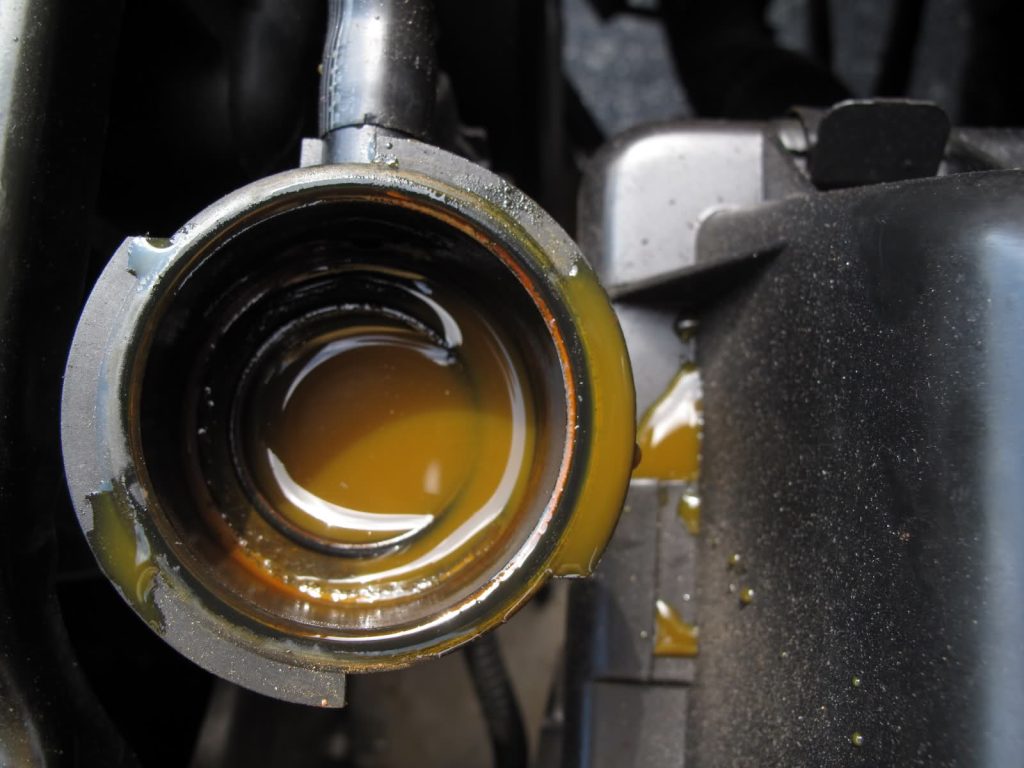
Brown coolant means ₹50,000 in repairs waiting to happen. Oily sheen means ₹40,000 head gasket failure already started. Here’s how to read what your coolant is telling you.
Why Coolant Color Reveals Hidden Disasters
A 2017 Honda City asking ₹7.2 lakhs looks well-maintained. Service records show regular oil changes, new tires, fresh brake pads. You pop the hood and check the coolant reservoir (plastic tank that stores extra coolant).
What you see: Brown, murky liquid with a slight oily film on the surface.
You: “When was the coolant last changed?”
Seller: “Coolant is lifetime. Never needs changing.”
You request a compression test before purchase. The mechanic connects a compression gauge to each spark plug hole (ignition device that creates spark to burn fuel) and cranks the engine.
Results:
- Cylinder 1: 180 psi (normal)
- Cylinder 2: 180 psi (normal)
- Cylinder 3: 180 psi (normal)
- Cylinder 4: 160 psi (low—should be 175-185 psi)
Diagnosis: Early-stage head gasket failure. The head gasket (seal between cylinder head and engine block) is leaking. Oil is seeping into coolant (causing oily sheen). Combustion pressure is escaping from cylinder 4 (causing low compression).
Repair quote:
- Head gasket replacement: ₹32,000
- Cylinder head resurfacing: ₹8,000 (head warped from overheating)
- Coolant flush: ₹2,500
- Total: ₹42,500
Seller’s asking price: ₹7.2 lakhs Your action: Walk away. Seller is hiding ₹42,000 in imminent repairs.
2 months later: Same car relisted at ₹6.8 lakhs with “head gasket replaced” in description. Seller paid for repair after market rejected the car.
In simple terms: Coolant isn’t just colored water—it’s a carefully formulated fluid with corrosion inhibitors that protect metal surfaces. When coolant ages beyond 2-3 years, these inhibitors fail, corrosion begins, and the entire cooling system deteriorates from the inside out.
Understanding Coolant Types & Lifespan
What is coolant?
Coolant (also called antifreeze) is a mixture of ethylene glycol or propylene glycol (chemical base that raises boiling point and lowers freezing point) + water + corrosion inhibitors + dye (color).
Three main purposes:
- Heat transfer – Absorbs heat from engine, carries to radiator
- Boiling point elevation – Raises boiling point from 100°C (water) to 120°C when pressurized to 16 psi
- Corrosion prevention – Protects aluminum, cast iron, copper, brass from rust and corrosion
Coolant Types in India
| Type | Color | Lifespan | Used In | Notes |
|---|---|---|---|---|
| IAT (Inorganic Acid Technology) | Bright green | 2 years / 40,000 km | Older cars (pre-2010) | Cheapest, shortest life |
| OAT (Organic Acid Technology) | Orange/Pink | 5 years / 100,000 km | Modern cars (2010+) | Most common in new cars |
| HOAT (Hybrid OAT) | Yellow/Red | 5 years / 100,000 km | European cars (VW, Skoda, Audi) | Extended life formula |
CRITICAL: Never mix different coolant types.
Mixing green (IAT) + orange (OAT) causes chemical reaction → sludge formation → clogged radiator → overheating → head gasket failure (₹40,000+).
In simple terms: Think of coolant types like blood types. Mixing incompatible types causes problems. If you don’t know what type is in your car, flush completely and refill with manufacturer-recommended type.
The Coolant Inspection Protocol
Where to check: Expansion tank (also called overflow reservoir)—a translucent plastic tank usually near the radiator with MIN and MAX markings.
Why check expansion tank instead of radiator? Safer (no risk of burns from hot pressurized coolant) and faster (no need to remove radiator cap).
Step-by-Step Inspection
Step 1: Locate expansion tank
Location: Engine bay, usually on passenger side near firewall or next to radiator
What it looks like: Translucent white or semi-clear plastic bottle with coolant visible inside, 2-3 markings (MIN, MAX, COLD/HOT)
Step 2: Observe coolant level (ENGINE COLD)
✅ Good level: Between MIN and MAX marks when cold, MAX mark when hot ❌ Problem: Below MIN mark = leak or consumption (burning coolant through head gasket)
Step 3: Assess coolant color and clarity
Stand in good light (sunlight preferred) and observe liquid carefully.
Coolant Color Analysis: What It Reveals
✅ GOOD COOLANT (Safe to Buy)
Bright green (IAT coolant):
- Clear, transparent (can see to bottom of tank)
- Vibrant green color (like lime juice)
- No particles floating
- No oil film on surface
Bright orange or pink (OAT coolant):
- Clear, transparent
- Vibrant orange/pink (like orange juice or strawberry milk)
- No cloudiness
- No contamination
What it means: Coolant fresh or recently changed (within 1-2 years). Corrosion inhibitors active. System protected.
⚠️ AGED COOLANT (Needs Change Soon)
Darker green or orange:
- Still transparent but darker shade
- Slight opacity (can barely see to tank bottom)
- No brown color yet
What it means: Coolant approaching end of lifespan (2-3 years old). Schedule flush within 6 months (₹2,000-3,000) to prevent corrosion.
❌ BROWN/RUSTY COOLANT (₹50,000 Problem)
Appearance:
- Brown or rusty color (like tea or dirty water)
- Murky, opaque (can’t see through it)
- May have sediment at tank bottom
What it means:
- Corrosion inhibitors completely depleted
- Rust forming in radiator, engine block, heater core
- Rust particles circulating through system
- Radiator tubes clogging internally (reducing cooling efficiency)
Immediate consequences:
- Overheating risk (clogged radiator can’t cool efficiently)
- Water pump impeller corrosion (₹6,000-12,000 replacement)
- Heater core clogging (₹8,000-15,000 replacement)
If ignored for 6-12 months:
- Radiator replacement: ₹8,000-15,000
- Engine overheating from clogged system
- Head gasket failure: ₹25,000-50,000
- Total: ₹40,000-70,000
Action: Flush system IMMEDIATELY (₹2,000-3,000). If car is for sale and seller refuses, walk away—they’re hiding ₹15,000-20,000 in deferred radiator/water pump replacements.
In simple terms: Brown coolant is like discovering termites in a house. The visible brown color means corrosion has already started eating away at metal surfaces. Flushing now might save the system; ignoring it guarantees expensive failures within 6-12 months.
❌ OILY SHEEN (₹40,000 Head Gasket Leak – CRITICAL)
Appearance:
- Thin oily film floating on coolant surface (looks like gasoline on water)
- Rainbow-colored sheen when light hits it
- Coolant may still be green/orange underneath the oil
What it means:
- Head gasket is leaking – Seal between cylinder head and engine block has failed
- Engine oil seeping into coolant passages
- Mixing of oil and coolant (two fluids that should NEVER meet)
How head gasket failure happens:
- Engine overheats (from neglected coolant, clogged radiator, or failed thermostat)
- Cylinder head expands from heat
- Head gasket (metal/composite seal) compresses beyond limits
- Seal fails, creating leak path between oil and coolant passages
Why it’s catastrophic:
- Oil in coolant → reduced cooling (oil doesn’t absorb heat like coolant)
- Continued overheating → warped cylinder head (₹8,000-15,000 to resurface)
- Coolant in oil → bearing damage (oil loses lubricating properties)
- Progressive failure → complete engine seizure possible
Repair cost:
- Head gasket replacement: ₹25,000-40,000
- Cylinder head resurfacing (if warped): ₹8,000-15,000
- Coolant flush + oil change: ₹3,500
- Total: ₹36,500-58,500
Action: DO NOT BUY without:
- Compression test (confirms head gasket leak)
- Cylinder head inspection (checks for warping)
- Negotiating ₹40,000-60,000 discount OR seller fixing before purchase
Real case: 2019 Maruti Baleno asking ₹6.8 lakhs had oily sheen. Buyer requested compression test. Cylinder 3 showed 155 psi (others 180 psi). Seller claimed “normal variance.” Buyer walked. Car relisted 3 months later at ₹6.2 lakhs with “head gasket replaced.”
❌ MILKY/FROTHY COOLANT (₹60,000 Severe Failure – WALK AWAY)
Appearance:
- Milky white or light brown color (like chocolate milk or coffee with cream)
- Frothy, foamy texture (like cappuccino foam)
- Thick, sludgy consistency
What it means:
- Severe head gasket failure – Oil + coolant + combustion gases all mixing
- Coolant has entered combustion chambers (burning during combustion)
- Oil has entered coolant system (completely contaminated)
- Combustion gases pressurizing cooling system (bubbles in coolant)
How to confirm:
- Start engine, watch expansion tank
- If bubbles continuously rise in coolant = combustion gases leaking = CRITICAL
Why it’s catastrophic:
- Cylinder head already warped (guaranteed ₹8,000-15,000 resurfacing needed)
- Possible piston ring damage from coolant in cylinders
- Possible bearing damage from coolant in oil
- May require complete engine rebuild (₹60,000-1,00,000)
Repair cost:
- Head gasket: ₹30,000-40,000
- Cylinder head resurfacing: ₹10,000-15,000
- New head bolts (must replace): ₹2,000-3,000
- Possible engine rebuild: ₹60,000-1,00,000
- Total: ₹42,000-1,00,000+
Action: WALK AWAY. Even with ₹60,000 discount, you’re buying someone else’s catastrophic failure. Banks may refuse financing. Resale value will be zero (“rebuilt engine” history).
❌ SLUDGY/THICK COOLANT (₹8,000 Flush Needed)
Appearance:
- Thick, gel-like consistency (doesn’t flow freely)
- Dark color with visible particles
- Settles at bottom when car sits
What it means:
- Coolant severely overdue for change (5-8 years old)
- Corrosion inhibitors completely gone
- Sediment and rust accumulated
- System internally clogged
Repair needed:
- Complete system flush (multiple cycles): ₹5,000-8,000
- Possible radiator removal for internal cleaning: ₹3,000-5,000
- New coolant: Included in flush
- Total: ₹5,000-13,000
Action: Negotiate ₹10,000-15,000 discount for complete cooling system service.
❌ WHITE PARTICLES/DEPOSITS (₹6,000 Descaling Flush)
Appearance:
- White chalky particles floating or settled at bottom
- Grainy texture (like sand or salt crystals)
- Coolant may be otherwise normal color
What it means:
- Calcium and mineral deposits from tap water
- Owner used tap water instead of distilled water + coolant mix
- Hard water minerals precipitating out (like limescale in kettle)
Why it’s a problem:
- Deposits clog narrow radiator tubes (reduce cooling 20-30%)
- Heater core clogging (weak cabin heat)
- Water pump impeller buildup (reduced flow)
Repair needed:
- Descaling flush (acidic solution to dissolve deposits): ₹4,000-6,000
- Complete coolant replacement with proper mix: ₹2,500
- Total: ₹6,500-8,500
In simple terms: Using tap water in cooling system is like using hard water in your washing machine—minerals build up, clog narrow passages, and reduce efficiency. Always use distilled water (₹40-50 per liter) or pre-mixed coolant.
The Smell Test
How to perform:
- Open expansion tank cap (ENGINE COLD ONLY)
- Smell coolant carefully (don’t inhale deeply—ethylene glycol is toxic)
✅ Normal smell: Sweet, slightly chemical smell (ethylene glycol’s natural odor)
❌ Problem smells:
- Burnt smell (like burnt rubber or oil) = overheating history, coolant boiled
- No smell (odorless like water) = plain water used instead of coolant (NO corrosion protection)
- Petroleum smell (like gasoline) = fuel leak into coolant (very rare, severe issue)
Coolant Level Drop Patterns
Normal behavior: Level stays constant. May drop 100-200ml over 6 months (evaporation from expansion tank).
Problem patterns:
Daily/Weekly Drops (Active Leak)
Level drops 500ml-1L per week:
- External leak (radiator, hoses, water pump, heater core)
- Check ground for green/orange puddles
- Check engine bay for stains
Action: Find and fix leak (₹2,000-15,000 depending on component)
Slow Drop with No Visible Leak (Head Gasket Consumption)
Level drops 1-2L per month, no puddles, no external leaks:
- Coolant burning in combustion chamber (head gasket leak)
- Coolant enters cylinders, burns with fuel, exits as white smoke
How to confirm:
- White smoke from exhaust (especially on cold start) = coolant burning
- Sweet smell from exhaust = burning coolant
- Compression test shows low cylinder pressure
Action: Head gasket replacement (₹25,000-50,000)
When to Flush vs When to Walk Away
✅ FLUSH RECOMMENDED (₹2,000-8,000)
Conditions:
- Coolant is brown but not oily
- No bubbles in expansion tank when engine running
- Compression test shows all cylinders equal (175-185 psi)
- No white smoke from exhaust
Cost: ₹2,000-8,000 (simple flush to complete descaling)
Action: Negotiate discount equal to flush cost, proceed with purchase
❌ WALK AWAY (₹40,000-1,00,000 Repair)
Conditions:
- Oily sheen on coolant (head gasket leak)
- Milky/frothy coolant (severe head gasket failure)
- Bubbles rising in expansion tank when running (combustion gases)
- Compression test shows unequal cylinders (difference >10 psi)
- White smoke from exhaust
Repair cost: ₹40,000-1,00,000
Action: Walk away OR negotiate 50%+ discount (buyer beware—resale impossible)
Pingback: Cooling System Failures – CarQ – Smarter Used Car Decisions