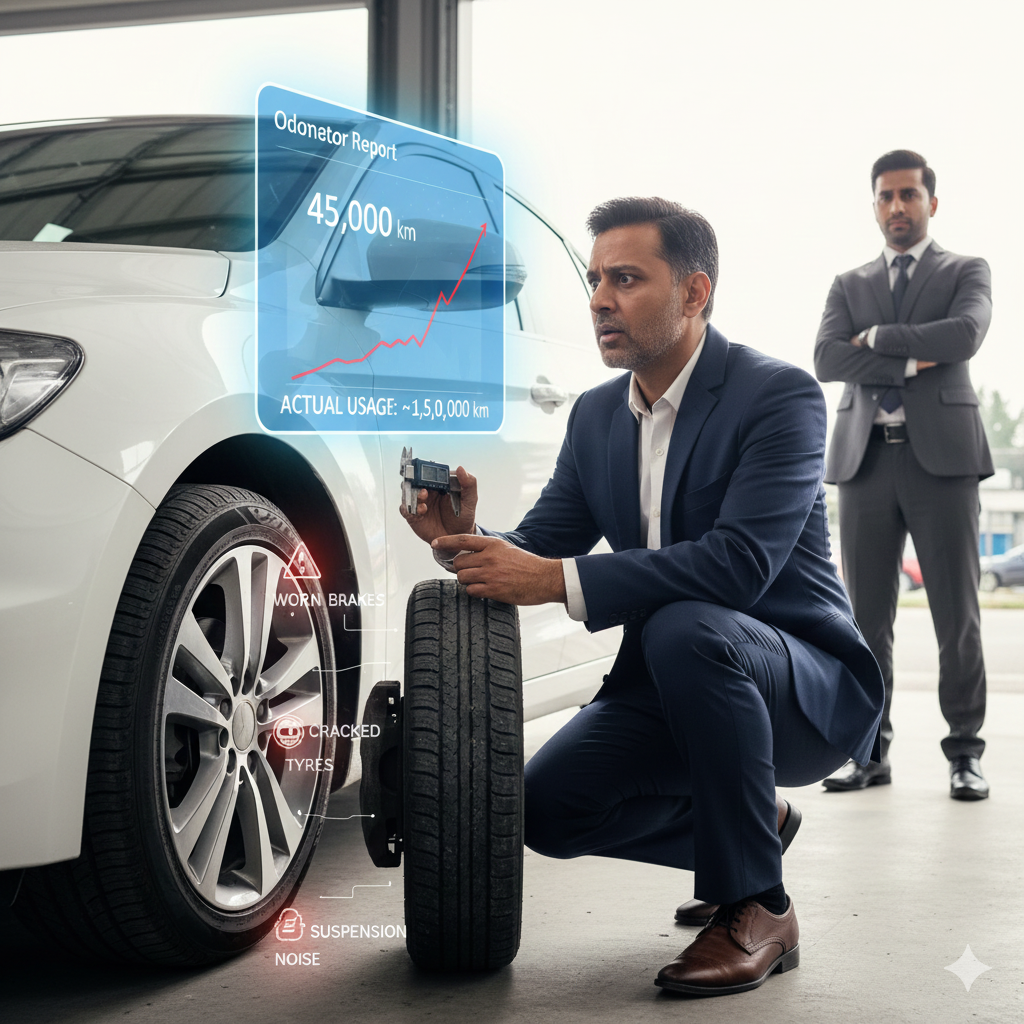
The odometer says 42,000 km. The tires say 69,000 km. The brake pads say 47,000 km. The steering wheel says 80,000+ km. Three physical components can’t all be wrong—but the odometer can.
While service records can be hidden and odometers can be hacked, physical wear is unforgeable. Tires, brake pads, pedals, and steering wheels wear at predictable rates. When you measure this wear and calculate backwards, you get the real mileage—independent of what the dashboard claims.
This is forensic mileage verification. Here’s how to read the physical evidence that sellers can’t fake.
Why Physical Wear Doesn’t Lie
Every component has a lifespan:
- Tires: 40,000-60,000 km
- Brake pads: 30,000-80,000 km (depending on city vs highway)
- Steering wheel leather: Shows shine at 60,000+ km
- Pedal rubber: Smooth at 80,000+ km
- Clutch (manual): 60,000-100,000 km
The key insight: When a seller rolls back the odometer from 90,000 km to 45,000 km, they can’t roll back the tire wear, brake pad thickness, or steering wheel shine. The physical evidence stays frozen at 90,000 km of usage.
In simple terms: Think of it like tree rings. You can change the sign that says “20-year-old tree,” but you can’t remove the 20 rings inside the trunk. Physical wear is the car’s “rings”—undeniable proof of real age and usage.
Tire Tread Depth: The Most Reliable Indicator
Tires wear at a predictable rate. Measuring tread depth reveals real mileage with 85-90% accuracy.
How Tires Wear
New tire specifications:
- Tread depth: 7-8mm (factory fresh)
- Wear rate: 0.1–0.12 mm (front) and 0.05–0.06 mm (rear) per 1,000 km (normal driving conditions)
- Legal minimum: 1.6mm (below this = unsafe and illegal)
- Expected lifespan: 40,000-60,000 km
In simple terms: Tire tread is the grooved rubber that touches the road. It wears down slowly with every kilometer. Think of it like pencil eraser—starts thick, gets thinner with use, eventually becomes unusable.
How to Measure Tread Depth
What you need: Tread depth gauge (₹200-500 at any auto parts store) OR 1-rupee coin
Coin method (if you don’t have gauge):
- Insert 1-rupee coin into tire groove (with Ashoka symbol down)
- If symbol is fully visible: Tread is 2mm or less (replace soon)
- If symbol is half-covered: Tread is ~4mm (50% life remaining)
- If symbol is mostly covered: Tread is 6mm+ (good condition)
Gauge method (more accurate):
- Place gauge probe into deepest groove
- Press down until base touches tire surface
- Read measurement in mm
Check all 4 tires – Measure at 3 points per tire (inner, center, outer edge)
Calculating Real Mileage from Tread Depth
Formula:
Worn tread = Original depth - Current depth
Real mileage = Worn tread ÷ 0.08mm per 1,000 km
Example 1: Original tires still on car
- Current tread depth: 2.5mm (measured)
- Original depth: 7.5mm (assume factory standard)
- Worn tread: 7.5 – 2.5 = 5mm
- Real mileage: 5 ÷ 0.08 = 62,500 km
If odometer shows 42,000 km, fraud of 20,500 km detected.
Example 2: Tires replaced once
Check DOT date code on tire sidewall (4-digit number like “2521” = 25th week of 2021)
- Tire manufactured: Week 25, 2021 (Jun 2021)
- Current date: Jan 2025 (3.5 years ago)
- Current tread depth: 3.5mm
- Worn tread: 7.5 – 3.5 = 4mm
- Mileage on these tires: 4 ÷ 0.08 = 50,000 km
If service records show tires replaced at 45,000 km:
- Real current mileage = 45,000 + 50,000 = 95,000 km
- If odometer shows 62,000 km: Fraud of 33,000 km detected
In simple terms: You’re using the tire like a ruler. Measure how much has worn away, do simple math, and you know how far the car has traveled—regardless of what the odometer claims.
Red Flags with Tires
1. Tires too new for claimed mileage
- Odometer: 85,000 km (5-year-old car)
- Tires: Brand new, 7.5mm tread
- Red flag: Tires replaced very recently. Why? Possible reasons:
- Real mileage is 120,000+ km (tires wore out naturally)
- Seller replaced tires to hide wear evidence before selling
2. Mismatched tire brands/dates
- Front: MRF, manufactured 2022
- Rear: Apollo, manufactured 2024
- Red flag: Tires replaced at different times, possibly after excessive wear
3. Tread depth doesn’t match claimed mileage
- Odometer: 35,000 km (3-year-old car)
- Tires: 2mm tread depth
- Calculation: 5.5mm worn = 69,000 km of usage
- Verdict: Odometer rolled back by ~34,000 km
Brake Pad Thickness: Cross-Verification
Brake pads wear faster than tires but provide valuable cross-verification.
How Brake Pads Wear
New brake pad specifications:
- Thickness: 12mm (factory fresh)
- Wear rate (city driving): ~0.15mm per 1,000 km
- Wear rate (highway driving): ~0.10mm per 1,000 km
- Replacement threshold: 3mm (below this = dangerous)
In simple terms: Brake pads are friction pads that squeeze your wheels to stop the car. Every time you brake, a tiny bit of pad material wears away. City driving (frequent braking) wears them faster than highway (less braking).
How to Check Brake Pad Thickness
Without removing wheel:
- Turn steering wheel fully left (to check right front)
- Look through wheel spokes at brake caliper
- You’ll see pad edge between caliper and rotor
- Estimate thickness visually (or use flashlight and ruler)
For accurate measurement: Ask mechanic to check during test drive (takes 2 minutes per wheel)
Calculating Real Mileage from Brake Pads
Example: City-driven car
- Current pad thickness: 5mm (front pads)
- Original thickness: 12mm
- Worn: 12 – 5 = 7mm
- Assuming city driving: 7 ÷ 0.15 = 47,000 km
If odometer shows 28,000 km, fraud of 19,000 km detected.
Cross-Verification Logic
Example: Tires say 65,000 km, brake pads say 48,000 km
- Interpretation: Car was driven mostly on highway (less brake wear)
- Average real mileage: (65,000 + 48,000) ÷ 2 = ~57,000 km
If odometer shows 35,000 km: Fraud of 22,000 km confirmed
In simple terms: When two independent measurements (tires and brakes) both point to much higher mileage than the odometer, you’ve mathematically proven fraud. It’s like two witnesses testifying against the seller’s story.
Red Flags with Brake Pads
1. Brake pads replaced recently
- Odometer: 42,000 km
- Service invoice: “Brake pads replaced” (dated 3 months ago)
- Question: Why did pads need replacement at 39,000 km? Normal lifespan is 50,000+ km
- Likely answer: Real mileage was 80,000+ km
2. Brake pads too worn for claimed mileage
- Odometer: 38,000 km (3-year-old car)
- Brake pads: 4mm remaining (60%+ worn)
- Calculation: 8mm worn = 53,000+ km usage
- Verdict: 15,000 km hidden
Interior Wear: The Overlooked Evidence
Interior components wear predictably and are the hardest for sellers to fake.
Steering Wheel Wear Patterns
Leather steering wheels:
- 0-40,000 km: Leather feels soft, no shine, texture intact
- 40,000-60,000 km: Slight shine starts appearing on grip areas (3 o’clock, 9 o’clock positions)
- 60,000-80,000 km: Noticeable shine, leather smoothening
- 80,000+ km: Heavy shine, leather compressed and smooth, feels slippery
In simple terms: Your hands’ natural oils and friction slowly wear down the leather texture. Just like your phone’s screen protector gets smoother over time, steering wheels get shinier. This process can’t be faked.
What to check:
- Grip areas (3 and 9 o’clock) – Most wear happens here
- Bottom of wheel (6 o’clock) – Less wear (hands rarely rest here)
- Stitching – If original stitching is intact but leather is heavily worn = high mileage
Red flag: Odometer shows 35,000 km but steering wheel has heavy shine and smooth texture = Real mileage 70,000+ km
Pedal Rubber Wear
Accelerator, brake, and clutch pedals:
- 0-50,000 km: Rubber texture visible, grooves intact
- 50,000-80,000 km: Grooves wearing down, becoming shallow
- 80,000+ km: Rubber smooth, grooves nearly gone, sometimes metal showing through
Clutch pedal (manual cars) wears fastest – Left foot repeatedly presses it
What to check:
- Compare pedals to each other (clutch wears fastest, brake second, accelerator least)
- Look for metal showing through rubber (indicates 100,000+ km)
- Check if pedals were recently replaced (rubber looks too new for car’s age)
Red flag: Odometer 45,000 km, but clutch pedal rubber is completely smooth with metal visible = Real mileage 90,000+ km
Seat Bolster Compression
Seat bolsters are the side cushions that hold you in place during turns.
Driver seat wears more than passenger seat (always compare both):
- 0-50,000 km: Bolsters firm, no sagging
- 50,000-80,000 km: Slight compression, leather may crack on entry/exit point
- 80,000+ km: Noticeable sagging, cracks, leather may be torn
What to check:
- Sit in driver seat – does it feel saggy compared to passenger seat?
- Check leather for cracks on seat edge (where you slide in/out)
- Feel cushion firmness – heavily used seats feel flat
Red flag: Odometer 40,000 km, but driver seat is heavily compressed and passenger seat is firm = Real mileage 70,000+ km
Door Scuff Plates
Scuff plates are metal/plastic strips where your feet touch when entering the car.
Wear patterns:
- 0-40,000 km: Minor scratches
- 40,000-80,000 km: Noticeable scuffing, paint wearing off
- 80,000+ km: Heavy scuff marks, bare metal visible (if metal plate)
Component Replacement Red Flags
Certain parts only need replacement after high mileage. If replaced “early,” real mileage is much higher.
Clutch Replacement (Manual Cars)
Normal clutch lifespan:
- City driving: 60,000-80,000 km
- Highway driving: 80,000-100,000 km
- Poor driving habits: 40,000-60,000 km (riding clutch, aggressive starts)
If service records show clutch replaced:
- Check mileage at replacement
- If replaced at “25,000 km” = Either defective (very rare) OR real mileage was 70,000+ km
In simple terms: Clutches are designed to last 80,000+ km with normal use. If one “failed” at 25,000 km, either the previous owner drove terribly (bad sign) or the odometer was already tampered before the replacement (real mileage was much higher).
Timing Belt Replacement
Replacement interval: 80,000-100,000 km OR 5 years (whichever comes first)
If timing belt replaced:
- Check when it was replaced
- If invoice shows “replaced at 35,000 km for preventive maintenance” = Suspicious
- Why replace a ₹15,000-25,000 component early unless real mileage was 85,000+ km?
Battery Replacement
Battery lifespan: 3-5 years (less mileage-dependent, more time-dependent)
Not a reliable mileage indicator – Batteries fail due to age, not just mileage
Cross-Correlation: Putting It All Together
The most powerful fraud detection comes from combining multiple measurements.
Real Example: 2019 Hyundai Creta
Seller’s claim: 42,000 km, single owner, excellent condition
Physical inspection findings:
| Component | Measurement | Indicated Mileage |
|---|---|---|
| Tires (original) | 2.5mm tread depth | 5mm worn ÷ 0.08 = 62,500 km |
| Brake pads (front) | 5mm remaining | 7mm worn ÷ 0.15 = 47,000 km |
| Steering wheel | Heavy shine, smooth texture | 70,000-80,000 km |
| Clutch pedal | Rubber smooth, grooves gone | 80,000+ km |
| Driver seat | Bolster compressed, cracks | 70,000+ km |
Average indicated mileage: 66,000-74,000 km
Claimed odometer mileage: 42,000 km
Discrepancy: 24,000-32,000 km (36-57% fraud)
Service records check revealed:
- Last documented service (Jul 2022): 78,300 km
- Current odometer: 42,000 km
- Backward jump: 36,300 km rollback confirmed
Verdict: Fraud probability 98%. Real mileage ~78,000-82,000 km. Walk away or demand ₹2.5-3 lakh discount.
Your Physical Inspection Checklist
Bring with you:
- Tread depth gauge (₹200-500) OR 1-rupee coin
- Flashlight (to see brake pads through wheel spokes)
- Smartphone camera (photo evidence of wear)
Check these components:
- All 4 tires: Measure tread depth, check DOT date codes
- Brake pads: Visual check through wheels (front more important than rear)
- Steering wheel: Feel texture, check for shine and smoothness
- Pedals: Check rubber wear, especially clutch (if manual)
- Driver seat: Compare firmness and condition to passenger seat
- Door scuff plates: Check wear level
Calculate and compare:
- Tire-indicated mileage
- Brake-indicated mileage
- Interior wear-indicated mileage range
- Average all measurements
- Compare to odometer reading
Decision:
- Within 10%: Acceptable
- 10-25% higher: Moderate fraud, negotiate or investigate further
- 25%+ higher: Major fraud, walk away
How CarQ Professional Inspection Helps
CarQ’s 408-point inspection includes:
Tire analysis:
- Tread depth measurement (all 4 tires, 3 points each = 12 measurements)
- DOT date code recording
- Mileage calculation based on wear
- Replacement history verification
Brake system check:
- Pad thickness measurement (all 4 wheels)
- Rotor wear assessment
- Mileage calculation based on wear rate
Interior wear documentation:
- Steering wheel condition (photo evidence with rating)
- Pedal wear assessment
- Seat condition comparison (driver vs passenger)
- Gear knob and handbrake wear
Component lifespan verification:
- Clutch condition test (if manual)
- Service records review for major replacements
- Age-appropriate wear validation
Cross-correlation analysis:
- AI compares all physical wear indicators
- Calculates average indicated mileage
- Compares to odometer and service records
- Provides fraud probability score
Final verdict:
Physical wear analysis:
  - Tire-indicated mileage: 68,000-72,000 km
  - Brake-indicated mileage: 62,000-66,000 km
  - Interior wear: 70,000-80,000 km
  - Average: 70,000 km

Odometer reading: 45,000 km
Service record last entry: 78,300 km (Jul 2022)

Cross-verification conclusion:
  Fraud probability: 96%
  Estimated real mileage: 77,000-82,000 km
  Odometer rollback: ~35,000 km
  Value overpayment risk: ₹2,20,000

Recommendation: REJECT
Key Takeaways
✓ Tire tread depth reveals real mileage – Formula: Worn tread ÷ 0.08mm = km traveled
✓ Brake pads cross-verify tire findings – City wear: 0.15mm/1,000 km, highway: 0.10mm/1,000 km
✓ Steering wheel shine appears at 60,000+ km – Heavy shine = 80,000+ km usage
✓ Pedal rubber smoothness indicates 80,000+ km – Especially clutch pedal on manual cars
✓ Component replacements reveal truth – Clutch at 25,000 km? Real mileage was 70,000+ km
✓ Cross-correlation is most powerful – Average 3-4 measurements for 90%+ accuracy
✓ Physical wear can’t be faked – Odometers lie, tires and pedals don’t
Related Guides:
- Mileage Verification Methods Overview – Complete fraud detection system
- Service Record Analysis – Timeline verification and gaps
- Interior Wear Patterns – Detailed wear assessment
Trust physics, not the dashboard. Get a professional CarQ inspection for tread depth measurement, brake pad analysis, and cross-correlated mileage verification with photo evidence.
Pingback: Mileage Verification Methods: Cross-Checking the Truth – CarQ – Smarter Used Car Decisions