The service invoice from July 2022 shows 78,300 km. Today’s odometer shows 45,000 km. One is lying—and it’s not the invoice.
Service records are your most powerful weapon against odometer fraud because they create a chronological mileage trail that’s nearly impossible to fake across 5+ years. While rolling back an odometer takes 30 minutes and ₹3,000, forging consistent service invoices, windshield stickers, door jamb labels, and authorized dealer digital records across multiple years is practically impossible.
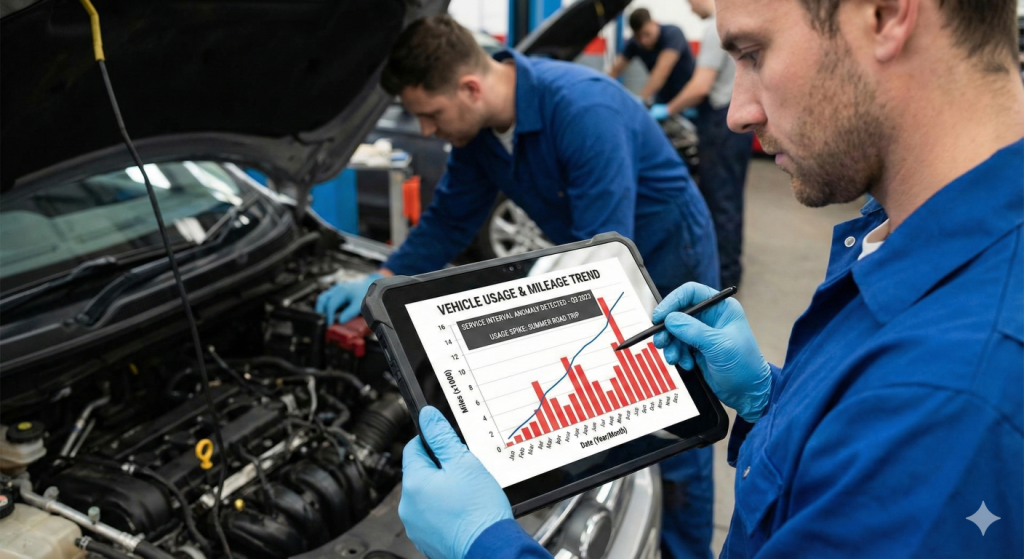
When you plot these records on a timeline and calculate intervals, backward jumps and suspicious gaps appear like neon signs. Here’s how to build your fraud-detection timeline.
What Service Documents Record Mileage
Service invoices (from authorized service centers)
- Oil changes, repairs, inspections
- Every invoice shows: Date, mileage, work performed, cost
- In simple terms: These are your receipts from the car service center. Every time the owner got the car serviced, the mechanic wrote down the kilometer reading.
Service booklet stamps
- Physical booklet that comes with the car
- Stamped and signed by service center at each visit
- Shows: Date, mileage, service type
Windshield service stickers
- Often placed in top-left corner
- Shows: Next service date, next service mileage, current mileage when placed
Door jamb stickers
- Sometimes placed on driver’s door frame
- Records: Service date, mileage, oil type changed
Extended warranty documents
- If car has extended warranty (beyond manufacturer’s 3-5 year warranty)
- Mileage recorded at warranty purchase and each claim
Insurance claim repairs
- Body shop repair invoices
- Shows mileage at time of accident repair
How to Create Your Mileage Timeline
Step 1: Collect All Mileage Entries
Request from seller:
- ALL service invoices (not just recent—go back to purchase date)
- Service booklet (physical or digital)
- Any extended warranty paperwork
- Insurance claim documents (if any repairs done)
Where to look during inspection:
- Windshield stickers (check all corners)
- Door jamb stickers (driver door frame)
- Glove box (old invoices often stored here)
- Service booklet in car documents folder
In simple terms: You’re collecting every piece of paper or sticker that shows a kilometer reading and a date. The more you collect, the harder it is for fraud to hide.
Step 2: Plot Chronological Chart
Create a simple table (pen and paper works fine):
| Date | Source | Mileage | Days Since Last | Interval (km) | km/day |
|---|---|---|---|---|---|
| Jan 2020 | Invoice | 12,450 | – | – | – |
| Jul 2020 | Sticker | 24,800 | 180 days | +12,350 | 68 |
| Jan 2021 | Invoice | 38,200 | 185 days | +13,400 | 73 |
| Jul 2021 | Sticker | 51,600 | 180 days | +13,400 | 74 |
| Jan 2022 | Invoice | 65,100 | 185 days | +13,500 | 73 |
| Jul 2022 | Invoice | 78,300 | 180 days | +13,200 | 73 |
| Current | Odometer | 45,000 | 550 days | -33,300 | FRAUD |
How to calculate:
- Interval: Current mileage minus previous mileage
- km/day: Interval ÷ days elapsed
In simple terms: You’re creating a history of how many kilometers were added between each service. If someone drove 70 km/day consistently for 3 years and then suddenly the odometer goes BACKWARD, fraud is obvious.
Step 3: Identify Usage Patterns
Normal usage patterns:
- City driver: 20-40 km/day (6,000-12,000 km/year)
- Average driver: 30-50 km/day (10,000-18,000 km/year)
- Highway commuter: 50-80 km/day (18,000-30,000 km/year)
Red flag: Sudden unexplained change (70 km/day drops to 15 km/day, then back to 60 km/day)
Red Flag Patterns That Reveal Fraud
Pattern 1: Backward Jump (Smoking Gun)
Example timeline:
Jan 2021: 38,200 km
Jul 2021: 51,600 km (+13,400 - normal)
Jan 2022: 65,100 km (+13,500 - normal)
Jul 2022: 78,300 km (+13,200 - normal)
Jan 2023: Should be ~91,500 km based on pattern
Current odometer: 45,000 km ❌ ROLLED BACK 46,500 km
Verdict: Odometer tampered between Jul 2022 and today
When you show this to seller:
- Seller: “Oh, the odometer was replaced due to malfunction”
- You: “Show me the replacement invoice with before/after readings”
- Seller: “I don’t have it”
- You: Walk away immediately
In simple terms: The numbers went UP consistently for years, then suddenly JUMPED BACKWARD. That’s impossible unless someone rewound the odometer.
Pattern 2: Suspicious Usage Gap (Likely Fraud Window)
Example timeline:
Jan 2020 to Jul 2020: +12,350 km (68 km/day) - Consistent
Jul 2020 to Jan 2021: +13,400 km (73 km/day) - Consistent
Jan 2021 to Jul 2021: +13,400 km (74 km/day) - Consistent
Jul 2021 to Jan 2022: +2,900 km (16 km/day) ❌ SUSPICIOUS
Jan 2022 to Jul 2022: +7,800 km (43 km/day) - Back to normalish
Current: 78,300 km
Analysis:
- Owner drove 70 km/day consistently
- Suddenly drives only 16 km/day for 6 months
- Then resumes 43 km/day
Likely explanation: Odometer was rolled back during the Jul 2021-Jan 2022 period, creating artificially low interval
True mileage estimation:
- If 70 km/day pattern continued: ~13,000 km should have been added
- Only 2,900 km shown = 10,000 km hidden
- Current odometer 78,300 km + 10,000 = Real mileage ~88,000 km
In simple terms: Imagine you walk 5,000 steps daily for months, then suddenly your step counter shows 800 steps for a week, then back to 4,500 daily. Either you were bedridden (unlikely if no medical reason) or someone tampered with the counter.
Pattern 3: Missing Service Records (Fraud Opportunity Window)
Example timeline:
Jan 2019 to Jan 2020: Records available (5 invoices)
Jan 2020 to Jul 2020: Records available (3 invoices)
Jul 2020 to Jul 2021: NO RECORDS ❌
Jul 2021 to Current: Records available (6 invoices)
Red flag: 12-month gap in service records
Possible reasons:
- Odometer tampering during gap – Owner doesn’t want documented mileage during fraud
- Commercial use – Car was taxi/rental (high mileage), then converted to private
- Sold and bought back – Ownership changed, hiding mileage history
- Major accident – Car was being repaired for extended period
Your action: Calculate expected mileage based on before/after pattern
Example:
- Before gap: 70 km/day average
- After gap: 65 km/day average
- Gap duration: 365 days
- Expected mileage added: ~24,000-25,000 km
If odometer shows only 15,000 km added during that year, ~10,000 km is missing.
Common Seller Excuses (And How to Counter)
Excuse 1: “I Barely Drove During COVID Lockdown”
Your counter:
- COVID lockdowns in India: Mar-May 2020 (2 months), Apr-May 2021 (1.5 months)
- Total: ~3.5 months across 2 years
- Cannot explain 30,000-40,000 km gap
Ask for proof:
- “Show me your work-from-home letter or proof you didn’t commute”
- Most can’t provide—commuting resumed after initial lockdowns
Excuse 2: “I Serviced at Local Garage, No Records”
Your counter:
- “Why did you switch from authorized service (which you have records for) to local garage (no records)?”
- “What was the reason for switching during that specific period?”
Red flag: Switching from documented to undocumented service exactly when mileage timeline becomes suspicious
Excuse 3: “Odometer Was Replaced Due to Malfunction”
Your counter:
- “Show me the replacement invoice from authorized service center”
- “It should show before and after readings”
Legal requirement: Odometer replacements must be documented with before/after mileage
If seller can’t provide proof: Walk away – fraud confirmed
Excuse 4: “Previous Owner Drove Very Little”
Your counter:
- “Show me the complete service history from Day 1”
- Check if previous owner’s usage pattern was genuinely low (20-30 km/day), or if this is a fabricated excuse
Cross-verify: CarQ vehicle history shows ownership changes and mileage at each transfer
How CarQ AI Automates This Analysis
Manually plotting timelines takes 30-45 minutes. CarQ’s AI fraud detection does it in 5 seconds.
What CarQ does automatically:
- Extracts mileage from all service documents you upload
- Accesses digital service history from authorized dealers (using VIN)
- Cross-references insurance company databases (claim and renewal mileage)
- Pulls PUC certificate mileage from state RTO databases
- Plots chronological timeline with all data points
- Calculates km/day intervals
- Identifies anomalies (backward jumps, suspicious gaps, pattern changes)
- Assigns fraud probability score (0-100%)
- Estimates real mileage range with confidence interval
Example CarQ output:
Vehicle: 2019 Hyundai Creta Diesel
Claimed mileage: 45,000 km
Data sources analyzed: 11
  - Service invoices: 7
  - Insurance renewals: 4
  - PUC certificates: 2
  - Authorized dealer digital: 8 entries

Timeline analysis:
  - Average usage pattern: 72 km/day (2020-2022)
  - Last documented mileage: 78,300 km (Jul 2022)
  - Time elapsed since: 18 months
  - Expected current mileage: 117,000-122,000 km

Anomalies found:
  ❌ Backward jump detected (78,300 → 45,000 km)
  ❌ Usage drop from 72 km/day to -60 km/day (impossible)

Fraud probability: 97% (VERY HIGH)
Estimated real mileage: 115,000-120,000 km (95% confidence)
Value overpayment risk: ₹2,50,000-3,00,000

Recommendation: REJECT unless seller provides explanation with proof
Cost: ₹2,999 for complete report
Time saved: 45 minutes of manual plotting
Accuracy: 95%+ (vs ~60% for DIY analysis)
Your DIY Verification Checklist
If you want to do this yourself before buying a CarQ report:
Before car viewing:
- Request ALL service invoices from seller (via WhatsApp photos)
- Request service booklet photos
- Request insurance renewal documents (shows mileage)
During car viewing:
- Check windshield for service stickers (note mileage and dates)
- Check driver door jamb for stickers
- Look in glove box for old invoices
- Photograph all documents for later analysis
After viewing (at home):
- Create chronological table with all mileage entries
- Calculate intervals and km/day
- Identify patterns (consistent? gaps? backward jumps?)
- Compare with seller’s claimed usage story
Decision points:
- 0-10% discrepancy: Normal variation (acceptable)
- 10-20% discrepancy: Investigate further, ask questions
- 20-30% discrepancy: Likely fraud, demand proof or walk away
- 30%+ discrepancy OR backward jump: Definite fraud, walk away immediately
Key Takeaways
✓ Service records create unforgeable timeline – Plot chronologically to reveal fraud
✓ Normal usage: 30-50 km/day – Sudden changes indicate tampering window
✓ Backward jumps = smoking gun – Mathematically impossible without fraud
✓ Missing service gaps = fraud opportunity – Calculate expected mileage using before/after patterns
✓ Seller excuses need proof – “COVID lockdown” / “odometer replaced” requires documentation
✓ CarQ automates analysis – 11+ data sources analyzed in 5 seconds with 97% fraud detection accuracy
✓ DIY verification takes 30-45 minutes – Worth it to prevent ₹1.5-3 lakh overpayment
Related Guides:
- Mileage Verification Methods Overview – Complete fraud detection system
- Wear Pattern Correlation – Physical evidence of real mileage
- Odometer Fraud Detection – The ₹2 lakh scam explained
Don’t trust the odometer. Trust the timeline. Get a CarQ vehicle history report to automatically analyze service records, insurance data, and PUC certificates with AI-powered fraud detection.
Pingback: Mileage Verification Methods: Cross-Checking the Truth – CarQ – Smarter Used Car Decisions