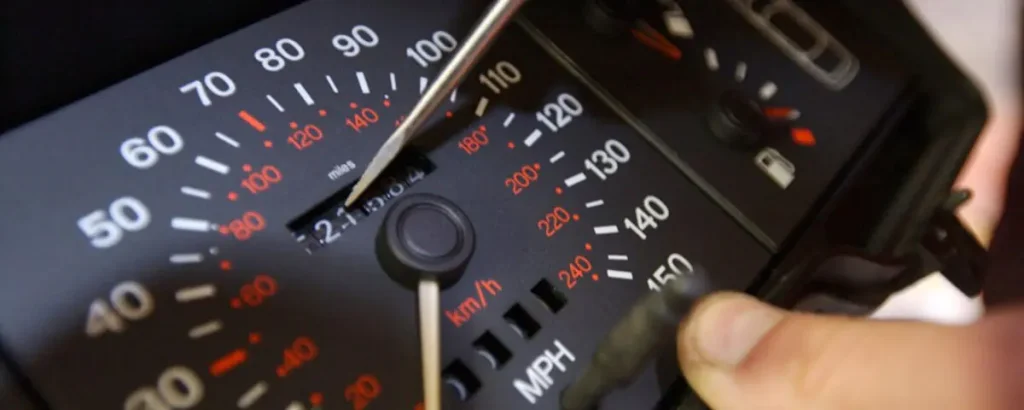
The odometer says 45,000 km. Service records say 78,000 km. Insurance documents say 92,000 km. One of them is lying—and it’s always the odometer.
With 70% of used cars having tampered odometers (the kilometer display on your dashboard), trusting that number is financial suicide. A car falsely advertised at 45,000 km instead of its real 90,000 km costs you ₹1,50,000-3,00,000 in overpayment plus premature component failures you didn’t budget for.
The seller knows the real mileage—they’re banking on you not knowing how to verify it.
In simple terms: Odometer fraud (rolling back the kilometer reading) is India’s most common used car scam. But while the odometer can be hacked in 30 minutes for ₹3,000, creating fake service records, insurance documents, and worn tires across 5 years is nearly impossible.
Why Odometer Fraud Is So Widespread
The economics of fraud:
- Cost to roll back odometer: ₹3,000-8,000 (takes 30 minutes)
- Value boost from fake low mileage: ₹1,50,000-3,00,000
- Detection rate without professional help: Less than 20%
A 2019 Hyundai Creta with 95,000 km real mileage sells for ₹9-9.5 lakhs. Roll it back to 45,000 km? Suddenly it’s “worth” ₹11-12 lakhs. That’s ₹2-2.5 lakh profit for 30 minutes of criminal work.
In simple terms: Odometer fraud has the highest ROI (return on investment – profit vs effort) of any used car scam. It’s quick, cheap, and most buyers never discover it until they face premature engine failure or try to resell.
What makes verification possible:
While odometers are easy to hack, creating a fake paper trail across 5+ years is nearly impossible. Service records, insurance renewals, PUC certificates (Pollution Under Control – mandatory emission test), and physical wear create independent verification sources that sellers can’t control.
What You Need to Verify
1. Service Record Analysis
Service invoices, booklets, and windshield stickers create a chronological mileage timeline. Plotting these reveals backward jumps, suspicious gaps, and usage patterns that expose fraud.
What to check:
- Timeline consistency (plotting all documented mileage)
- Average km/day calculations (normal: 30-50 km/day)
- Gaps in service history (missing years = fraud window)
- Multiple data sources (invoices + stickers + booklet)
Complete Service Record Analysis Guide →
2. Physical Wear Pattern Correlation
Tires, brake pads, steering wheel shine, and pedal rubber wear at predictable rates. When physical components show 80,000 km of wear but the odometer claims 45,000 km, the truth is visible.
What to check:
- Tire tread depth measurement (wear rate: ~0.08mm per 1,000 km)
- Brake pad thickness (wear rate: ~0.15mm per 1,000 km city driving)
- Interior wear (steering wheel, pedals, seat bolsters)
- Component replacements (clutch, timing belt lifespan)
Complete Wear Pattern Correlation Guide →
How CarQ Detects Odometer Fraud
CarQ’s vehicle history report cross-references 8-12 independent data sources:
- Insurance company databases – Mileage at renewals and claims
- Service center records – Digital service history from authorized dealers
- RTO records – Mileage at registration transfers
- PUC certificates – Annual emission test mileage
- Previous CarQ inspections – If car was inspected before
- OBD-II ECU data – Multiple electronic control units store mileage independently
AI fraud detection analyzes:
- Timeline inconsistencies (backward jumps, suspicious gaps)
- Usage pattern changes (sudden drop from 70 km/day to 15 km/day)
- Physical wear correlation (tire/brake wear vs claimed mileage)
- Multi-source discrepancies (when 5+ sources contradict odometer)
Example fraud detection:
Dashboard odometer: 45,000 km
Service records average: 78,000 km (last documented 18 months ago)
Insurance renewal mileage: 82,000 km (6 months ago)
PUC certificate: 76,000 km (1 year ago)
Engine ECU stored mileage: 94,000 km
Tire wear calculation: 85,000-90,000 km

Fraud probability: 97% (VERY HIGH)
Estimated real mileage: 92,000-96,000 km
Value overpayment: ₹2,20,000
Red Flags That Scream “Walk Away”
Instant deal-breakers:
- Seller refuses service records – “I lost them” / “Don’t have them”
- Backward mileage jump – Service record shows 78,000 km, current odometer shows 45,000 km
- Suspicious usage gap – Consistent 70 km/day for 3 years, then suddenly 15 km/day
- Missing service history window – Records before/after 2020, but none during 2020
- Physical wear mismatch – Odometer 40,000 km, but steering wheel shows 80,000+ km shine
- ECU mileage discrepancy – OBD scan shows engine ECU at 88,000 km, dashboard at 42,000 km
When you spot these patterns, assume fraud and walk away. No “good deal” justifies buying a tampered vehicle.
Deep Dive Resources
For comprehensive understanding of mileage verification, read these detailed guides:
Service Record Analysis →
Master timeline verification, mileage progression tracking, and gap detection. Learn to plot chronological charts, calculate km/day averages, identify backward jumps, and decode seller excuses when confronted with evidence.
Wear Pattern Correlation →
Understand how tire tread depth, brake pad thickness, interior wear, and component replacements reveal real mileage. Learn measurement techniques, wear rate calculations, and cross-correlation methods.
Your Action Plan
Never buy without this three-layer verification:
- Request all documents (before viewing)
- Complete service history (all invoices, booklets, stickers)
- Insurance renewal documents (5+ years)
- PUC certificates (all available years)
- Run independent verification via CarQ vehicle history
- Shows mileage from insurance, RTO, service centers
- AI fraud detection with probability score
- Estimates real mileage range
- Professional physical inspection via CarQ used car inspection
- Tire tread depth measurement
- Brake pad thickness check
- OBD-II ECU mileage scan
- Interior wear assessment
Total cost: ₹3,000-5,000 for complete verification
What it prevents: ₹1,50,000-3,00,000 overpayment + premature failures
ROI: 3,000-10,000% return on investment
Real Case: The “Low Mileage” Creta
Listing: 2019 Hyundai Creta diesel, 48,000 km, asking ₹12.2 lakhs
Seller’s story: “Single owner, barely used, mostly parked during COVID”
CarQ verification revealed:
- Insurance renewal Jan 2023: 86,000 km
- Service record Jul 2022: 81,500 km
- PUC certificate Mar 2023: 88,200 km
- Engine ECU scan: 91,300 km
Physical inspection confirmed:
- Tires: 2.8mm tread (indicates 65,000+ km on current set)
- Brake pads: 4mm front (indicates 50,000+ km usage)
- Steering wheel: Heavy shine (80,000+ km indicator)
Fraud probability: 98%
Estimated real mileage: 90,000-93,000 km
Value at real mileage: ₹9-9.5 lakhs
Overpayment risk: ₹2.7-3.2 lakhs
Buyer walked away. Seller later admitted to odometer rollback after confronted with evidence.
Key Takeaways
✓ 70% of used cars have tampered odometers – Assume fraud until cross-verification proves otherwise
✓ Service records create mileage timeline – Plot chronological chart, look for backward jumps and suspicious gaps
✓ Physical wear reveals truth – Tire tread depth, brake pads, interior wear correlate with real mileage
✓ Insurance documents are independent proof – Renewal and claim mileage cross-verifies service records
✓ ECU scans catch digital fraud – Multiple modules store mileage independently, exposing rollback
✓ Cross-verification is mandatory – When 5+ sources contradict odometer, fraud is undeniable
✓ Prevention costs ₹3,000-5,000 – Professional verification prevents ₹1.5-3 lakh overpayment
Ready to verify real mileage? Start with a quick vehicle search to verify VIN and basic details, then get a comprehensive CarQ vehicle history report for AI-powered fraud detection and real mileage estimation.