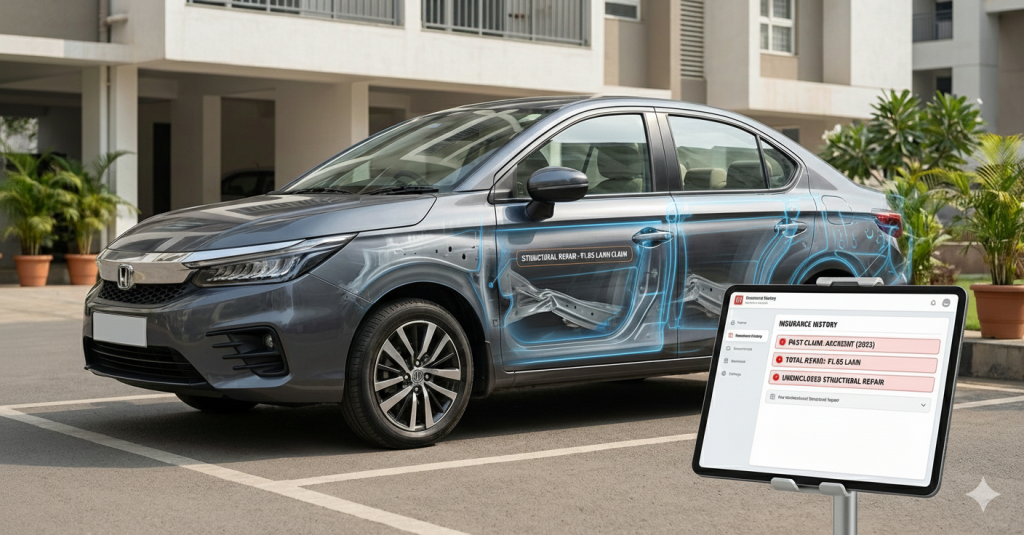
That “accident-free” claim from the seller? The insurance database tells a different story. A ₹1.85 lakh hidden claim, undisclosed structural repairs, and a car worth ₹3 lakhs less than asking price—all discoverable through one check.
Insurance records don’t lie. They’re the permanent paper trail revealing what sellers hide—accident history, repair costs, and total loss declarations.
How to Request Claim History
Order a CarQ vehicle history report which pulls data from all major insurers—ICICI Lombard, HDFC Ergo, Bajaj Allianz, TATA AIG, and more.
What you receive:
- Complete claim history from all insurers
- Claim dates, amounts, and types
- Claim descriptions (frontal impact, rear collision, flood)
- Total loss declarations
- Cross-state claims that local checks miss
In simple terms: CarQ’s national database catches claims filed anywhere in India, even if the seller changed states or switched insurers to hide accident history.
Why seller records aren’t enough: Sellers “lose” paperwork, switch insurers, or re-register in another state to hide claims. CarQ checks all insurers nationwide via permanent chassis number (VIN).
Understanding Claim Types: ODO vs TP
ODO (Own Damage): Insurance pays to repair your car’s damage from accidents, theft, fire, flood, or vandalism.
Claim severity guide:
- ₹10,000-30,000 = Minor (bumper, lights) – 5-10% value loss
- ₹30,000-80,000 = Moderate (panels, possible airbags) – 15-20% value loss
- ₹80,000+ = Major (structural damage) – 30-50% value loss
TP (Third Party): Insurance pays for damage you caused to others (another car, property, person). Doesn’t indicate damage to the car you’re inspecting—focus on ODO claims.
In simple terms: ODO claims mean the car itself was damaged. Claims over ₹80,000 indicate serious structural damage that permanently compromises safety.
Example report:
2023-06-10 | ODO Claim | ₹1,85,000 | "Frontal impact - radiator support,
bonnet, fenders, headlights, suspension"
Red flag: ₹1.85 lakh claim = major damage. If seller didn’t disclose it, walk away.
Total Loss Indicators: The Salvage Title Risk
When repair costs exceed 75% of market value, insurers declare total loss (write-off/salvage title).
Example: 2020 Creta worth ₹12 lakhs with ₹9.5 lakh damage = 79% ratio = TOTAL LOSS
What happens:
- Insurance pays IDV (Insured Declared Value) – the car’s current market value
- Ownership transfers to insurer
- Vehicle marked “salvage” in VAHAN database (national vehicle registry)
- Should be scrapped or auctioned for parts
The fraud: Some total loss vehicles get “rebuilt” with cheap parts and resold without disclosure. VAHAN (Vehicle Registration database maintained by Ministry of Road Transport) shows salvage status—CarQ report flags these instantly.
Red Flag Patterns to Spot
Multiple small claims = major problem:
5 claims in 2 years (₹18K, ₹22K, ₹15K, ₹28K, ₹19K) reveals accident-prone driver. Even small individual claims mean cumulative structural damage and tanked resale value.
In simple terms: A car with 3+ claims is like a repeatedly-dropped phone. Structure weakens with each impact, even if repairs look good.
Why “no claims ≠ no accidents”:
Sellers pay minor repairs out-of-pocket to keep NCB (No Claim Bonus) – annual premium discount of 10-50% for not filing claims. They also avoid creating claim history that hurts resale.
Detection: Look for paint overspray, panel gaps, and spot weld irregularities (see Visual Inspection Guide).
Cross-State Fraud: How Sellers Hide Claims
Common tactic:
Seller has ₹1.5 lakh Delhi accident → re-registers in Maharashtra (new RC number) → switches insurers → sells as “accident-free.” Local checks show clean history.
How CarQ catches it:
CarQ’s national database cross-references via chassis number (VIN) – permanent identifier unchanged by re-registration. Delhi claim appears instantly even with Maharashtra RC.
In simple terms: Changing states or insurers doesn’t erase claims. VIN is the permanent fingerprint linking all records nationwide.
Real Case: 2021 Creta with ₹1.85 Lakh Hidden Claim
Seller’s story:
- 2021 Hyundai Creta SX Diesel, 32,000 km
- Asking ₹15.5 lakhs
- “Single owner, no accidents, showroom-maintained”
- Fresh paint, perfect panels, clean service book
CarQ report revealed:
Date: 2023-06-18 | Bajaj Allianz
Claim: ₹1,85,000 ODO
Damage: "Frontal collision - radiator support, bonnet, fenders,
headlights, bumper reinforcement, suspension components, paint"
Repair costs:
- Radiator support (structural frame): ₹35,000
- Bonnet + fenders: ₹45,000
- Headlights + fog lights: ₹28,000
- Bumper reinforcement: ₹18,000
- AC condenser: ₹12,000
- Front suspension: ₹22,000
- Paint: ₹25,000
Total: ₹1,85,000
What this means:
The radiator support (structural frame behind bumper) and suspension were replaced = moderate-to-major frontal impact. Crumple zones (parts designed to absorb crash impact) have been compromised.
In simple terms: The car hit something hard enough to damage the frame. Even perfect repairs can’t restore original crash protection. Your family’s safety is permanently reduced.
The confrontation:
Buyer showed seller the report. Seller: “I forgot about that” + offered ₹50K discount. Buyer walked away.
Reality: Creta’s true value after ₹1.85L claim = ₹11-12 lakhs, not ₹15.5 lakhs. Attempted fraud: ₹3.5-4.5 lakhs.
How CarQ caught it:
Seller switched from Bajaj Allianz to ICICI Lombard and re-registered Gujarat→Maharashtra after accident. Local checks showed “clean.” CarQ’s VIN-based national database pulled the Gujarat claim instantly.
Key Takeaways
✓ CarQ report saves ₹50,000-3,00,000 – National database catches cross-state hidden claims via VIN
✓ ODO claims over ₹80,000 = walk away – Structural integrity permanently compromised
✓ Total loss vehicles resold illegally – VAHAN + CarQ reveals salvage status
✓ 3+ claims in 2 years = red flag – Cumulative damage tanks value and reliability
✓ No claims ≠ no accidents – Verify with visual inspection (panel gaps, paint overspray)
Pingback: Accident History 101: How to Spot a Repaired Car (Even When It Looks Perfect) – CarQ – Smarter Used Car Decisions