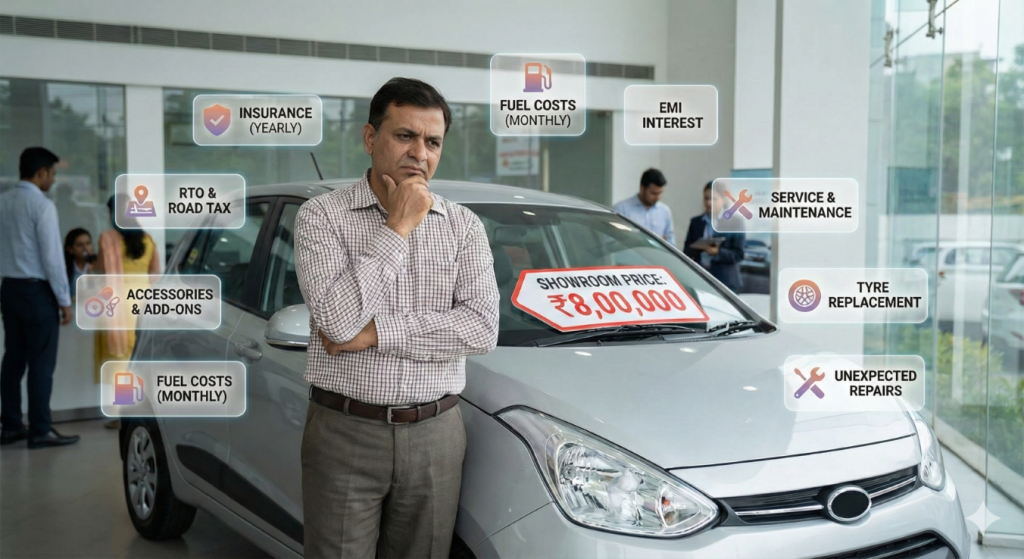
The showroom price is never the full story. It’s not exactly a lie, but it’s definitely not the whole truth. Many car buyers only realise this after their purchase, when the actual expenses start piling up. That ₹8-lakh quote you hear from the sales executive? That’s just the starting point of a much bigger financial journey.
Owning a car costs a lot more than the number printed on the brochure. There are immediate charges, recurring expenses, and a bunch of hidden costs that show up later. Put together, these can increase your total spending by 40–60% within just the first three years.
Here’s something most people don’t know:
An average Indian car buyer underestimates their first-year car expenses by ₹1.2–1.5 lakhs.
That’s not a small difference — it’s enough to turn a happy purchase into unnecessary financial stress.
This guide breaks everything down in simple language. From the moment you sign the papers to the day you decide to sell the car, we’ll walk you through every expense you should expect. More importantly, we’ll help you plan your budget smartly so you don’t get hit with surprise costs later.
The Complete Cost Breakdown: Where Your Money Really Goes
A. Purchase Costs: The Day-One Shock
When you buy a car priced at ₹10 lakhs ex-showroom, here’s what you actually pay:
Mandatory Costs (What You MUST Pay):
- Ex-showroom Price: ₹10,00,000 (the base car price before any additions)
- RTO Registration: ₹1,00,000-1,20,000 (10-12% varies by state) – this is for getting your number plate legally
- Comprehensive Insurance: ₹35,000-45,000 (first year) – covers damage to your car + others
- Road Tax: Included in RTO charges (permission to drive on public roads)
- TCS (Tax Collected at Source): ₹10,000 (1% government tax if car price exceeds ₹10 lakhs)
- Logistics/Handling: ₹5,000-8,000 (dealer charges to transport car from warehouse)
Optional but Common (Dealer Will Push These):
- Extended Warranty: ₹15,000-50,000 (extra coverage after standard 2-3 year warranty ends – worth it for complex models)
- Zero Depreciation Add-on: ₹8,000-15,000 (insurance pays full part cost, not depreciated value – essential for new drivers)
- Accessories Package: ₹20,000-50,000 (mats, seat covers, upgraded music system, etc.)
- Ceramic Coating/PPF: ₹20,000-80,000 (protective layer for paint – like a screen guard for your car)
Total Day-One Cost: ₹11,80,000 to ₹12,50,000 (18-25% above sticker price)
For Used Cars, Additional Costs:
- Transfer Charges: ₹1,500-5,000 (RTO fees)
- NOC (if interstate): ₹5,000-10,000
- Vehicle History Report: Get CarQ vehicle history analysis for complete background check
- Pre-purchase Inspection: Professional 200-point CarQ inspection – ₹2,000-5,000
- Immediate Repairs: ₹10,000-50,000 (varies by condition)
- Insurance Transfer/Renewal: ₹15,000-30,000
Used car buyers often face a cruel surprise: that ₹5 lakh “deal” becomes ₹5.5-6 lakhs after transfer, immediate repairs, and insurance renewal.
B. Financing Costs: The Interest Iceberg
Most buyers finance 70-80% of their purchase. Here’s the real math:
New Car Loan Example (How Much You Really Pay):
- Car Price: ₹10,00,000
- Down Payment: ₹3,00,000 (amount you pay upfront in cash)
- Loan Amount: ₹7,00,000 (balance amount bank gives you)
- Interest Rate: 8.5% per year (the cost of borrowing money)
- Tenure: 5 years (how long you take to repay)
- EMI: ₹14,370 (fixed amount you pay every month)
- Total Interest Paid: ₹1,62,200 (extra cost for borrowing – on top of ₹7 lakh loan!)
- Processing Fee: ₹14,000 (2% one-time bank charge to process your loan)
Used Car Loan Reality (Why It’s More Expensive):
- Higher Interest: 12-15% (vs 8-9% for new) – banks charge more for used cars
- Shorter Tenure: 3-4 years maximum (can’t stretch repayment as much)
- Lower LTV (Loan-to-Value): 70-80% of car value (banks lend less, you pay more upfront)
- Higher Processing: 2-3% of loan amount (bigger bank charges)
The 20% Rule (Can You Actually Afford This Car?):
Your EMI (monthly payment) shouldn’t exceed 20% of your monthly income.
C. Running Costs: The Monthly Bleed
These recurring expenses often shock first-time owners:
Fuel Costs (Monthly):
- City Driving (50 km/day): ₹5,000-7,000 (petrol)
- Mixed Use (60 km/day): ₹6,000-8,000
- Diesel Premium: Save ₹1,500-2,000/month
- CNG Savings: ₹3,000-4,000/month lower
Insurance Renewal (Annual Cost That Keeps Changing):
- Year 2: ₹25,000-35,000 (20% cheaper due to depreciation)
- Year 3: ₹20,000-30,000 (30% cheaper – car worth less now)
- NCB (No Claim Bonus): 20% discount if you don’t make any insurance claim in a year – reward for safe driving!
- IDV (Insured Declared Value): This is your car’s current market value, decreases 10-15% every year
In simple terms: Insurance gets cheaper each year because your car is worth less (depreciation). Plus, if you don’t make claims, you get extra discounts!
Service & Maintenance:
Within Warranty (First 2-3 years):
- Minor Service: ₹4,000-8,000 (every 6 months)
- Major Service: ₹8,000-15,000 (annual)
- Warranty Coverage: Parts covered, labor charged
Post-Warranty Reality:
- Service Costs: Increase 40-60%
- Part Replacements: Your responsibility
- Brake Pads: ₹8,000-15,000 (every 30,000 km)
- Clutch Replacement: ₹20,000-35,000 (60,000-80,000 km)
D. Depreciation: The Silent Killer
What is Depreciation? Your car loses value every year, just like your phone or laptop. When you sell, you get less than what you paid.
Depreciation is your largest “expense” though you don’t pay it monthly – you feel it when selling:
Typical Depreciation Curve (How Much Value Your Car Loses):
- Year 1: 15-20% value loss (₹2,00,000 gone on a ₹10 lakh car!)
- Year 2: 12-15% additional loss
- Year 3: 10-12% additional loss
- Year 4-5: 8-10% loss each year
- 5-Year Total: 50-60% value lost
In simple terms: A ₹10 lakh car becomes worth only ₹4-5 lakhs after 5 years. That’s like ₹1 lakh disappearing every year!
Factors Affecting Depreciation:
- Brand: Maruti/Hyundai depreciate slower
- Segment: SUVs hold value better
- Color: White/silver best, unique colors worst
- Fuel Type: Diesel SUVs retain value
- Condition: Accident history drops 20-30%
E. Surprise Expenses: The Budget Breakers
These unexpected costs derail many ownership experiences:
Major Component Failures:
- AC Compressor: ₹15,000-25,000
- Suspension Overhaul: ₹20,000-40,000
- Transmission Repair: ₹50,000-1,00,000
- Engine Work: ₹30,000-80,000
Wear Items:
- Tires (set of 4): ₹15,000-40,000 (every 40,000 km)
- Battery: ₹5,000-15,000 (every 3-4 years)
- Wiper Blades: ₹1,500-3,000 (annual)
- Headlight Bulbs: ₹2,000-5,000
Body & Paint:
- Minor Dent Repair: ₹3,000-8,000
- Panel Painting: ₹8,000-15,000
- Windshield Replacement: ₹8,000-20,000
- Alloy Wheel Repair: ₹3,000-5,000/wheel
Budget Optimization Strategies
The Smart Buyer’s Playbook
1. Buy 1-2 Year Old:
- Skip steepest depreciation (save 20-30%)
- Maintain warranty benefits
- Get additional features within budget
- Lower insurance costs
2. Insurance Optimization:
- Compare online (save 20-30%)
- Choose correct IDV (not too high/low)
- Build NCB systematically
- Drop zero-dep after 3 years
3. Service Strategy:
- Follow schedule religiously during warranty
- Keep all records (adds 10% to resale)
- Use authorized service for first 2 years
- Find trusted independent mechanic post-warranty
4. The Emergency Fund Rule:
- Maintain ₹50,000 emergency repair fund
- Increases to ₹75,000 after 3 years
- Covers unexpected breakdowns
- Prevents credit card debt for repairs
5. Fuel Cost Management:
- Track actual mileage monthly
- Use apps for cheapest fuel stations
- Consider CNG for high-mileage use
- Maintain optimal tire pressure (improves 5-10%)
The CarQ Advantage: Budget Protection Through Intelligence
When buying used, hidden costs can destroy your budget. This is where CarQ’s comprehensive reports become your financial shield:
How CarQ Vehicle History Reports Save Money
Upcoming Maintenance Prediction: Our AI analyzes service patterns to predict:
- Next major service requirements
- Part replacement timelines
- Estimated costs for next 12 months
- Red flags indicating expensive repairs ahead
Accident History Impact:
- Structural damage: 30% value loss
- Multiple claims: Higher insurance premiums
- Repainted panels: Rust issues later
- Airbag deployment: Safety concerns
Service Gap Analysis:
- Missed services indicate neglect
- Irregular patterns suggest problems
- Local service history: Lower resale
- Complete records: 10-15% value addition
The Insurance Premium Calculator
CarQ reports reveal insurance claim history, helping you:
Red Flags: When Your Budget Is at Risk
Walk Away When You See:
Financial Red Flags:
- Loan/hypothecation pending
- Interstate transfer complications
- Commercial use history (depreciation accelerated)
- Modified vehicles (insurance issues)
Maintenance Red Flags:
- No service history (budget ₹50,000 for surprises)
- Multiple owners in short period
- Odometer tampering (impossible to budget)
- Major component replacement history
The 30% Rule: If immediate repairs exceed 30% of purchase price, walk away. That ₹4 lakh “deal” needing ₹1.5 lakh repairs isn’t a deal.
Coming Up Next in the Series:
“Think Long-Term: Resale Value & Common Issues”
A smart buyer thinks ahead: resale value, long-term reliability, and potential trouble areas.
Pingback: Quick Guide: Picking Your Car’s Fuel – Don’t Waste Lakhs – CarQ – Smarter Used Car Decisions
Pingback: From Confused to CarQ’ed – CarQ – Smarter Used Car Decisions
Pingback: Resale Value & Common Issues – Buying for Tomorrow – CarQ – Smarter Used Car Decisions