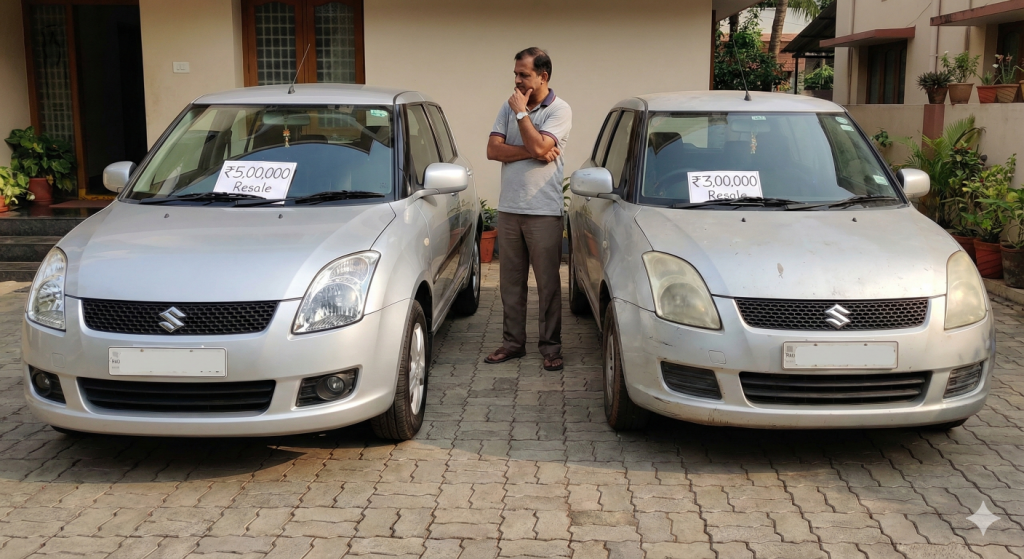
Two identical cars, same purchase date—one worth ₹3 lakhs after 5 years, the other ₹5 lakhs. The difference? One owner understood depreciation dynamics.
Every car purchase is also a future sale. Even your “forever car” will likely be sold within 5 years (Indian average: 5.2 years). Yet buyers focus entirely on purchase, ignoring the eventual exit that determines whether you lose ₹3 lakhs or ₹5 lakhs on your investment.
What you’ll learn:
- Brand hierarchy and retention rates (Maruti 60-65%, Volkswagen 35-45%)
- Depreciation factors (color, fuel type, transmission)
- Model-specific common issues by segment
- When to walk away vs negotiate
- CarQ’s predictive intelligence for resale value
Why Resale Value Matters
The 5-Year Reality
2020 Hyundai Creta purchased at ₹14 lakhs:
- With clean history: ₹8-9 lakhs in 2025 (60-65% retention)
- With accident history: ₹4-6 lakhs (30-45% retention)
- Difference: ₹3-4 lakhs lost to undisclosed damage
In simple terms: Your car is like a phone—it loses value every year (depreciation). But some brands hold value better, and damage/neglect accelerates the loss dramatically.
What You’ll Learn
This guide covers two critical areas:
Depreciation Factors →
Master brand hierarchy (Maruti vs Volkswagen vs luxury), color impact (white holds value, orange tanks), fuel type dynamics (diesel declining), transmission preferences (manual vs CVT resale), ownership count effects, and regional variations.
Model-Specific Issues →
Deep dive into common problems by segment: Budget hatchbacks (Alto clutch, Swift infotainment), compact sedans (City CVT overheating, Verna DCT judder), compact SUVs (Creta DCT, Nexon AMT), diesel universal issues (DPF, turbo, DMF), and EV battery degradation.
Brand Hierarchy and Retention Rates
The Champions (60-65% retention after 5 years):
- Maruti Suzuki: Unmatched service network, parts availability
- Toyota: Legendary reliability
- Hyundai: Strong brand, modern features
The Fighters (50-55%):
- Tata, Mahindra, Honda, Kia
The Strugglers (35-45%):
- Volkswagen, Skoda, Renault, Nissan
- High depreciation due to service cost fears, parts availability
Luxury Disaster (30-40%):
- Mercedes, BMW, Audi
- Massive depreciation + maintenance fears
Quick Depreciation Factors
Color impact:
- Winners: White (preferred 40%), Silver (25%), Grey (15%)
- Avoid: Orange, Yellow, Purple (5-10% value hit)
Transmission:
- Manual: Still 60% of used market, most reliable
- Torque Converter Auto: Commands premium, most reliable automatic
- CVT/DCT: Buyers hesitate due to reliability concerns
Ownership:
- Single owner: 10-15% premium
- Two owners: Standard pricing
- Three+ owners: 10-20% discount
- Ex-commercial (taxi): 40-50% discount
The CarQ Predictive Advantage
CarQ vehicle history report provides:
AI-powered insights:
- Model-specific failure pattern recognition
- Cost prediction algorithms (next year’s expenses)
- Resale value estimation
- Manufacturer recall tracking
Example prediction: “This 2019 Creta diesel shows service patterns indicating possible DPF issues within 6 months. Budget ₹35,000 for preventive cleaning. Turbo replacement likely at 95,000 km (currently 70,000 km).”
Decision Framework
Clean history + popular brand/color: → Pay market price, expect good resale
Accident history disclosed: → Negotiate 15-30% discount depending on severity
Model-specific known issues present: → Factor repair cost + 20% risk premium
Repair estimates exceed 50% of asking price: → Walk away (money pit)
Key Takeaways
✓ Brand matters: Maruti holds 60-65% value, Volkswagen only 35-45%
✓ Color affects resale: White/Silver/Grey preferred, bright colors tank value 5-10%
✓ Accident history reduces value 30-50%: Even professional repairs can’t restore full worth
✓ Model-specific issues are predictable: City CVT overheats, Verna DCT judders, Creta DPF clogs
✓ CarQ AI predicts failures: Know what repair is coming next year, budget accordingly
✓ 50% rule: Repair cost >50% of price = walk away
✓ Transmission affects resale: Manual strongest, torque converter premium, CVT/DCT hesitation
Checklist References
- service_history#1-5: Service gaps reveal neglect affecting resale
- pre_work#7: Accident history reduces value 30-50%
- engine_compartment#various: Model-specific engine issues
- obd_scan#all: Fault codes predict expensive repairs
For complete guidance: Complete Pre-Purchase Inspection Checklist
Next Steps
Check complete history → Accident claims, service patterns, ownership verification
Physical inspection → Verify condition matches asking price
Resale value isn’t luck—it’s understanding what holds worth and what tanks it. Buy smart, exit smart.
Coming Up Next in the Series:
“Don’t Skip the Service History – Especially for Used Cars”
A well-documented service record separates a good deal from a bad one.
Pingback: From Confused to CarQ’ed – CarQ – Smarter Used Car Decisions