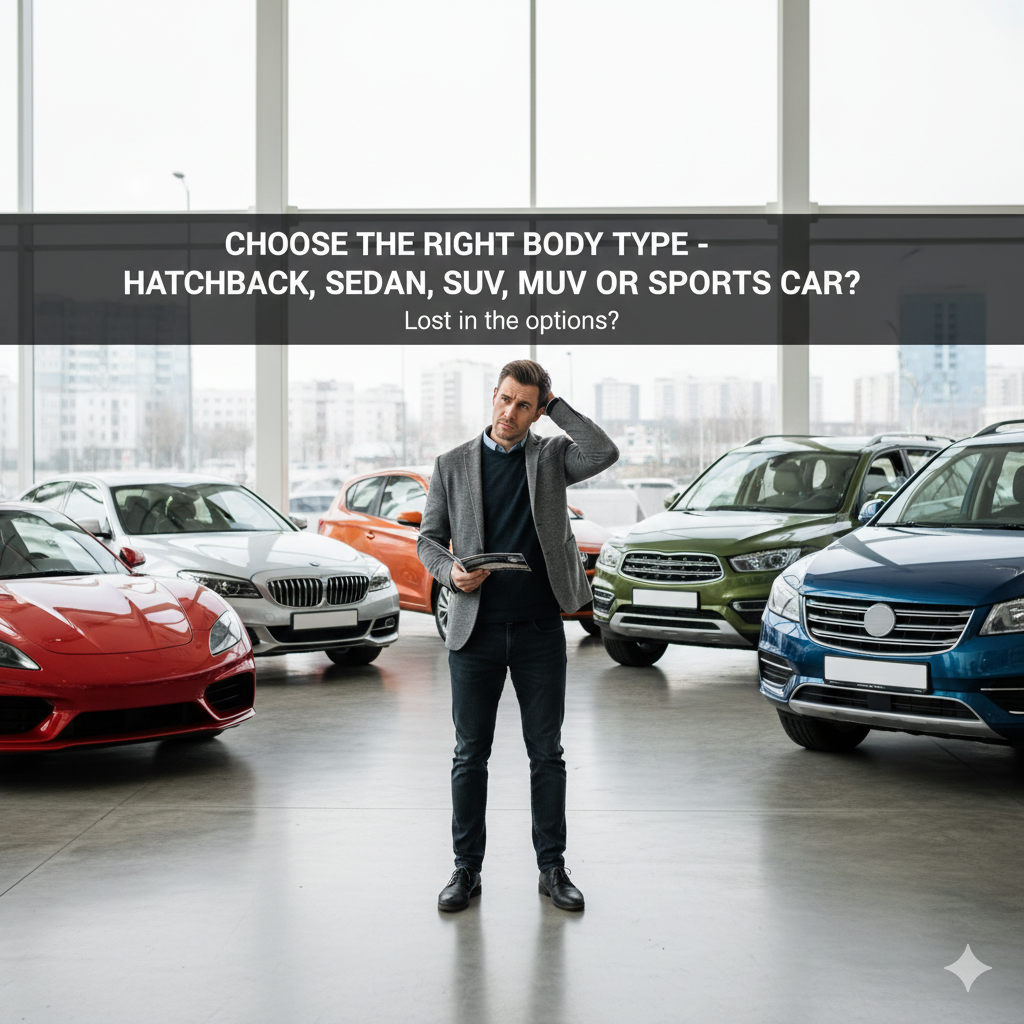
Choosing your first car—or even your next one—can feel overwhelming. Beyond brand loyalty and color preferences lies one of the most fundamental decisions that will impact your driving experience for years: the body type. Whether you’re navigating Mumbai’s tight parking spots or cruising Bangalore’s outer ring road, your car’s body type determines not just how you drive, but how you live with your vehicle every single day.
In India’s diverse automotive market, five body types dominate the conversation: Hatchbacks, Sedans, SUVs, MUVs, and the occasional Sports Car. Each comes with its own set of advantages, limitations, and surprisingly, unique maintenance considerations that many buyers overlook. Let’s decode which body type truly matches your lifestyle—not just your Instagram aesthetic.
Understanding Each Body Type: Beyond the Showroom Appeal
Hatchback: The City Champion
Best For: City driving, fuel efficiency seekers, easy parking needs
Hatchbacks remain India’s bestselling segment for good reason. Popular models like the Maruti Swift, Hyundai i20, and Tata Altroz have mastered the art of maximizing space within a compact footprint. With typical lengths under 4 meters, they slip into parking spots that would make SUV owners weep.
Ideal Buyer Profile:
- Young professionals navigating metro traffic daily
- Small families (2 adults + 2 kids max)
- First-time car buyers prioritizing running costs
- City dwellers with limited parking space
Hidden Considerations:
- Limited boot space (250-350 liters – roughly 3-4 large suitcases) struggles with airport runs for 4 people
- Rear seat comfort compromised for adults on long drives (think cramped knees on 3+ hour trips)
- Ground clearance (165mm or about 6.5 inches – distance from road to car’s bottom) makes broken roads challenging
- Highway stability – feels less planted at speeds above 100 km/h compared to heavier cars
Sedan: The Balanced Performer
Best For: Comfort seekers, highway cruisers, professional image
The Honda City, Hyundai Verna, and Maruti Ciaz represent the sedan philosophy: elegance meets practicality. With a separate boot compartment and longer wheelbase, sedans offer superior ride quality and a commanding road presence without the bulk of an SUV.
Ideal Buyer Profile:
- Corporate executives valuing comfort and image
- Families prioritizing passenger comfort over cargo space
- Daily highway commuters (Gurgaon to Delhi types)
- Buyers seeking better fuel efficiency than SUVs
Hidden Considerations:
- Boot loading height can be awkward for heavy luggage
- Rear passenger headroom limited compared to SUVs
- Speed breaker clearance requires careful navigation
- Declining resale value as market shifts toward SUVs
SUV: The Status Statement
Best For: Ground clearance needs, commanding road presence, versatile usage
The SUV boom shows no signs of slowing. From the compact Hyundai Venue to the imposing Toyota Fortuner, SUVs have captured India’s imagination. Models like Hyundai Creta, Kia Seltos, and Tata Harrier offer the perfect blend of practicality and presence.
Ideal Buyer Profile:
- Families needing space and flexibility
- Adventure enthusiasts (weekend getaways, mild off-roading)
- Status-conscious buyers seeking road presence
- Mixed city-highway drivers
Hidden Considerations:
- Higher fuel consumption (12-15 km per liter vs 18-20 for sedans) – you’ll spend 30-40% more on fuel
- Expensive tire replacements (₹20,000-40,000 for a set of 4) – larger tires cost significantly more
- Higher insurance premiums (20-30% more than sedans) – bigger car = bigger insurance bill
- Parking challenges in older building complexes – check your parking spot dimensions first
- Body roll (that leaning feeling in sharp turns) affects handling – SUVs aren’t as nimble as smaller cars
MUV (Multi-Utility Vehicle): The People Mover
Best For: Large families, maximum passenger capacity, commercial use
The Toyota Innova Crysta remains the undisputed MUV king, with the Maruti Ertiga and Kia Carens offering more affordable alternatives. With 7-8 seat configurations, MUVs prioritize people over pizzazz.
Ideal Buyer Profile:
- Joint families needing regular 7-seat capacity
- Travel enthusiasts (road trip groups)
- Commercial operators (hotel shuttles, tour operators)
- Buyers prioritizing reliability over features
Hidden Considerations:
- Third-row access can be cumbersome
- Fuel efficiency drops significantly when fully loaded
- Longer turning radius complicates city maneuvering
- Higher maintenance costs for commercial use
- Limited boot space with all seats up (300 liters becomes near zero)
Sports Car: The Heart’s Desire
Best For: Driving enthusiasts, weekend toys, making statements
While limited in India, sports cars like the BMW Z4 or Porsche 718 represent pure driving pleasure. These are emotional purchases where practicality takes a back seat—literally, since most have only two seats.
Ideal Buyer Profile:
- Car enthusiasts with deep pockets
- Collectors and hobbyists
- Young entrepreneurs making a statement
- Buyers with multiple cars for different needs
Hidden Considerations:
- Astronomical maintenance costs (service: ₹50,000+)
- Limited service center network
- Ground clearance nightmares on Indian roads
- Practically zero resale market
- Insurance premiums that could buy a small hatchback
Your Decision Framework: The 5-Point Reality Check
1. Family Size and Growth Plans
- Current needs vs. 3-year projection
- Occasional 5th passenger vs. daily requirement
- Elderly parents’ ingress/egress comfort
- Child safety seat space requirements
2. Primary Usage Pattern
- Daily commute distance and traffic conditions
- Weekend usage patterns
- Highway trips frequency
- Parking availability at home/office
3. Budget Beyond Purchase Price
- Fuel costs (SUVs consume 30-40% more)
- Insurance premiums variation
- Tire replacement costs
- Service and maintenance expenses
4. Image and Lifestyle Alignment
- Professional requirements
- Social circle considerations
- Personal satisfaction factors
- Long-term contentment probability
5. City Infrastructure Reality
- Road conditions in your area
- Parking spot dimensions
- Basement height clearances
- Service center accessibility
Quick Decision Tree: Which Body Type Is Right For You?
START HERE: What's your primary need?

├─ "I need easy parking & low running costs"
│  ├─ Daily city commute? → HATCHBACK ✓
│  └─ Occasional highway trips? → HATCHBACK ✓
│
├─ "I want comfort + professional image"
│  ├─ Mostly highway driving? → SEDAN ✓
│  └─ Balanced city/highway? → SEDAN ✓
│
├─ "I need space & road presence"
│  ├─ Family of 4-5 people? → SUV ✓
│  ├─ Broken roads common? → SUV ✓
│  └─ Weekend trips frequent? → SUV ✓
│
├─ "I regularly carry 6+ people"
│  ├─ Joint family trips? → MUV ✓
│  ├─ Commercial use? → MUV ✓
│  └─ Road trip groups? → MUV ✓
│
└─ "I'm a driving enthusiast"
   ├─ Have multiple cars already? → SPORTS CAR ✓
   └─ Only car? → Reconsider (impractical for daily use)

BUDGET CHECK:
💰 Can afford 30-40% higher fuel costs? → SUV/MUV possible
💰 Budget-conscious? → Hatchback/Sedan recommended

PARKING CHECK:
🅿️ Tight parking spot? → Avoid SUV/MUV
🅿️ Ample space? → Any body type works
Common Mistakes to Avoid
The allure of SUVs has many buyers overlooking practical realities. That commanding road presence means nothing when you’re doing three-point turns in your apartment parking. Similarly, choosing a sedan for “better mileage” makes little sense if you’re constantly scraping the underbody on speed breakers.
Don’t let test drive excitement override practical considerations. That turbocharged engine feels great on the highway, but calculate if you’ll pay ₹3 extra per kilometer in city traffic. Avoid choosing based purely on looks—that sporty low-slung sedan might look fantastic but will have you wincing at every speed bump.
Most importantly, don’t assume bigger is always better. Many compact SUV buyers could be happier (and richer) with a well-equipped hatchback. Unless you genuinely need the ground clearance or seven seats, the extra cost rarely justifies itself.
The CarQ Advantage: Body-Type Intelligence
When considering a used car purchase, body type influences inspection requirements significantly. SUVs and MUVs demand thorough underbody examinations due to their off-road pretensions—many urban SUVs hide serious underbody damage from overzealous weekend adventures.
CarQ’s used car inspection service adapts to each body type’s vulnerabilities. Hatchbacks get detailed suspension geometry checks (city pothole damage), sedans receive thorough boot floor inspections (accident damage often hidden here), while SUVs undergo comprehensive 4WD system verification and underbody protection assessment.
Our vehicle history reports reveal body-type-specific patterns. That used Creta might have transmission issues common to DCT variants, while the pre-owned City’s CVT gearbox requires specific service history verification. These insights, drawn from thousands of inspections, help you avoid costly mistakes.
Making Your Choice: The Final Word
Your perfect body type exists at the intersection of practical needs and emotional satisfaction. While that SUV might seem like the obvious choice in today’s market, remember that the best car is the one that fits your life, not your neighbor’s expectations.
Before finalizing your decision, especially in the used car market, arm yourself with data. A CarQ vehicle history report reveals how previous owners lived with that body type—city-only hatchbacks show different wear patterns than highway-driven sedans. Our comprehensive inspection service uncovers body-type-specific issues that casual buyers miss, potentially saving you lakhs in unexpected repairs.
Ready to find your perfect match? Start with a quick vehicle search to check basic RC details, then get a complete vehicle history report to understand the real ownership experience of your shortlisted models. Our body-type-specific insights and 200-point inspection ensure you choose not just the right type, but the right individual car. Because in the end, it’s not about choosing between a hatchback or an SUV—it’s about choosing the vehicle that’ll make every drive worthwhile.
Get Your CarQ Vehicle History Report →
Coming Up Next in the Series:
“Pick the Fuel Type That Matches Your Driving”
Select the fuel option that fits your commute, usage patterns, and long-term ownership goals.
Pingback: From Confused to CarQ’ed – CarQ – Smarter Used Car Decisions
Pingback: City Cruiser or Highway King? Choose Based on Usage Pattern – CarQ – Smarter Used Car Decisions